Last updated: . Reviewed by the WunderHub editorial team. Rental price data sourced from Wunderflats bookings, June 2025–May 2026.
Key takeaways
- The average monthly rent on Wunderflats in Munich is 1,832 EUR, with a median of 1,650 EUR — the highest in the Wunderflats network (Jun 2025–May 2026).
- The most common price tier is 1,501–2,000 EUR per month (38.0% of bookings), reflecting Munich's premium rental market.
- 52.7% of tenants book for work, 15.6% for study — reflecting Munich's dual identity as a corporate hub and university city.
- Munich is Germany's safest major city for the 50th consecutive year (Bayerische Polizei, Sicherheitsreport 2025).
- The Deutschland-Ticket (63 EUR/month) covers the entire MVV public transport network — no car needed.
- You must complete Anmeldung at the KVR within 14 days of moving in — this is your gateway to a tax ID and a German bank account.
Overview
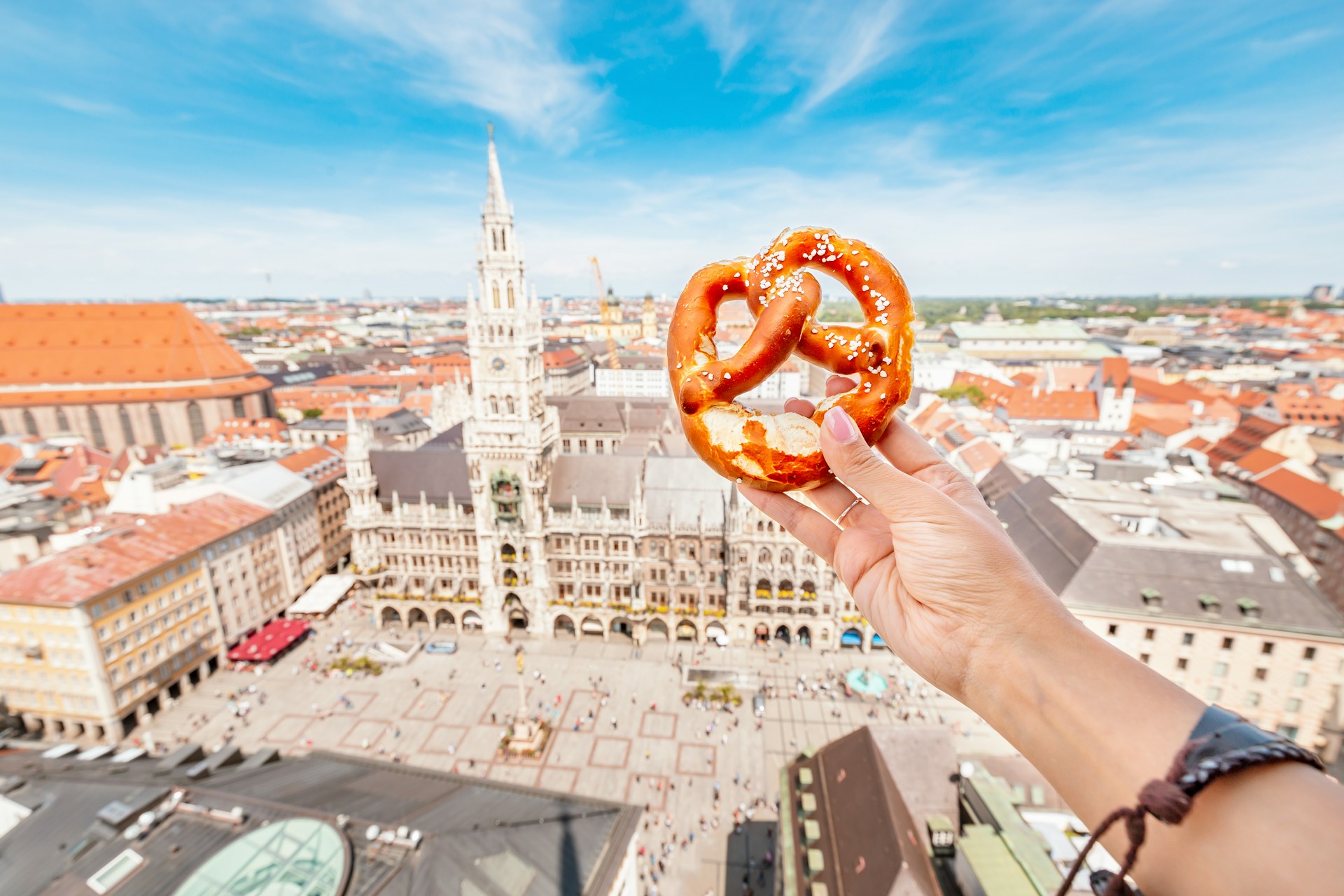
Munich (München) sits at the foot of the Alps in southern Germany and holds a unique position: it is simultaneously one of Europe's most liveable cities and its most expensive German one. The Bavarian capital blends baroque architecture, a thriving beer garden culture, and some of Germany's strongest research universities with headquarters of global corporations including BMW, Siemens, MAN, Munich Re, and Allianz. That combination draws a steady stream of international professionals, researchers, and students every year.
The city has around 1.6 million inhabitants and a metropolitan area of nearly 3 million. It sits roughly 60 km north of the Austrian border, making weekend escapes to the Alps, Salzburg, or Lake Starnberg effortlessly accessible. The Isar river runs through the city from south to north, dividing old-money neighbourhoods in the east from the university quarter in the west, and providing kilometres of green riverbanks that serve as Munich's informal living room in warmer months.
For newcomers, Munich rewards preparation. The rental market is tight and prices are high, the city requires formal registration (Anmeldung) within two weeks of arrival, and Oktoberfest — while iconic — brings a seasonal intensity to the city that affects short-term housing and daily life in September and October. With the right groundwork, though, Munich offers an unusually high quality of life: clean, safe, extremely well connected, and rich with culture. This guide covers everything you need to settle in confidently.
Key facts
| Category | Detail |
|---|---|
| Official name | München (Munich) |
| State | Bavaria (Bayern) |
| Population | ~1.6 million (city); ~3 million (metro area) |
| Area | 310 km² |
| Language | German (Bavarian dialect in informal settings); English widely spoken in business |
| Climate | Continental: warm summers (avg 24°C Jul), cold winters (avg -1°C Jan); alpine föhn winds common in spring/autumn |
| Public transport | MVV: 6 U-Bahn lines, 8 S-Bahn lines, tram network, extensive bus coverage |
| Key universities | LMU Munich (ranked top 50 globally), TU Munich (top 30 globally), Hochschule München |
| Key industries | Automotive (BMW, MAN), insurance and finance (Allianz, Munich Re), engineering (Siemens), tech and SaaS (Celonis, Personio), life sciences, media |
| Safety ranking | Germany's safest major city (200k+ inhabitants) for 50 consecutive years (Polizeipräsidium München, 2025) |
Neighbourhoods
Munich is divided into 25 official districts, but most expats settle in a handful of central and near-central areas. Rental prices across the city are uniformly high by German standards: even the more affordable outer districts often exceed the averages of other German cities. The chart below shows approximate average monthly rent for a one-bedroom furnished apartment by neighbourhood.
Average monthly rent, 1-bedroom furnished apartment by neighbourhood (Munich, 2025–2026)
Sources: Investropa Munich rent data 2025–2026; Homeboy Immo Munich district price data 2025. Figures are estimates for furnished 1-bedroom apartments; actual prices vary by size, floor, and landlord.
Maxvorstadt
The museum quarter directly north of the city centre houses the Pinakotheken art museums, LMU's main campus, and TU Munich's city campus. It is Munich's most academic and culturally dense neighbourhood, and predictably among its most expensive. Expats in research, academia, or creative industries tend to cluster here. Transport links are excellent: multiple U-Bahn lines and S-Bahn stops put the rest of the city within 10–15 minutes.
Schwabing
Schwabing is the classic expat landing zone. Stretching north from the Siegestor arch along Leopoldstraße to Münchner Freiheit, it mixes late-19th-century Gründerzeit apartment buildings with cafés, bookshops, and a relaxed, international atmosphere. The southern end borders the Englischer Garten, Europe's largest urban park. International staff at LMU and TU Munich are among the most common tenants. Expect to pay at the upper end of the city average for well-maintained Altbau apartments.
Au-Haidhausen
East of the Isar, Haidhausen (colloquially called the "French Quarter") offers Altbau charm at prices slightly below Schwabing and Maxvorstadt. Wiener Platz is the neighbourhood anchor, with a popular outdoor market, independent restaurants, and a strong café culture. S-Bahn and U-Bahn links are good, putting the centre under 10 minutes away. Creative professionals and tech workers favour this area for its lived-in feel and manageable commute.
Bogenhausen
Bogenhausen sits east of Schwabing along the Isar banks, and trades the student energy of Maxvorstadt for a quieter, more upscale character. Villas, embassies, and well-maintained apartment blocks dominate. Senior executives, diplomats, and families with children tend to prefer this district for its green spaces, good schools, and proximity to the Isar meadows. Prices are high but the quality of housing stock is consistently strong.
Neuhausen-Nymphenburg
West of the centre, Neuhausen-Nymphenburg combines the appeal of the baroque Nymphenburg Palace and its park with a relaxed, family-oriented neighbourhood feel. Rotkreuzplatz is the local hub, with good U-Bahn links to the city centre. Prices are slightly lower than the Schwabing–Maxvorstadt axis, making this one of the better-value options for families or longer-term stays.
Transport
Munich's transport is operated by the Münchner Verkehrsgesellschaft (MVG) and integrated into the wider MVV (Münchner Verkehrsverbund) regional network. The system covers the city and surrounding region comprehensively, and most expats manage without a car even for daily life.
| Ticket type | Price (2026) | Coverage |
|---|---|---|
| Single ticket (M-zone, inner city) | ~3.90 EUR | One journey within the Munich inner zone |
| Day ticket (single, M-zone) | ~9.60 EUR | Unlimited travel for one day, inner zone |
| IsarCard monthly (M-zone) | ~57–62 EUR | Unlimited monthly travel, inner Munich zone |
| Deutschland-Ticket | 63 EUR/month | All MVV services plus all regional trains nationwide |
| Airport connection (S1/S8) | ~13.90 EUR single | Munich city centre to Munich Airport (MUC), ~40 min |
For most residents, the Deutschland-Ticket at 63 EUR/month is the most practical choice: it covers S-Bahn, U-Bahn, tram, and bus within the MVV zone, plus regional trains (RE, RB, IRE) across all of Germany. Weekend trips to Nuremberg, Salzburg, or Innsbruck fall within reach on this single pass.
Munich is increasingly cycle-friendly. The city has over 1,200 km of marked cycle paths, and the flat terrain of the central neighbourhoods makes cycling practical year-round. Bike-sharing services (MVG Rad) offer short-term rentals from around 1 EUR for 30 minutes. Car ownership in the city is manageable but rarely necessary for expats living centrally: parking costs are high and the public transport network handles most journeys faster.
Cost of living
Munich is Germany's most expensive city. Rent accounts for the largest share of outgoings, and general living costs — groceries, dining, leisure — are also above the German average, though not dramatically so outside the city centre. A single professional can expect to spend between 2,500 EUR and 3,500 EUR per month all-in, depending on lifestyle and housing choice.
Wunderflats rental price distribution in Munich (% of standard bookings, Jun 2025–May 2026)
Source: Wunderflats internal data, Jun 2025–May 2026. Standard bookings, stays of 28 days or more. Bars show share of total bookings by price tier. Absolute volumes not published.
The average monthly rent on Wunderflats in Munich is 1,832 EUR and the median is 1,650 EUR, both the highest figures across all cities in the Wunderflats network. The most common tier — 1,501–2,000 EUR — accounts for 38% of bookings. Nearly a quarter of tenants pay above 2,000 EUR per month, reflecting strong demand from corporate and senior professional relocations.
| Expense | Monthly estimate (single person) |
|---|---|
| Furnished apartment (1-bed, central) | 1,500–2,000 EUR |
| Utilities (electricity, heating, water) | 150–200 EUR |
| Public transport (Deutschland-Ticket) | 63 EUR |
| Groceries | 300–350 EUR |
| Dining out (mid-range, occasional) | 150–250 EUR |
| Health insurance (employee, statutory) | ~17.5% gross salary (employer pays ~half) |
| Mobile (SIM-only contract) | 15–30 EUR |
| Estimated total (excl. insurance) | 2,200–2,900 EUR |
Note on utilities: Many furnished apartments on Wunderflats include utilities in the monthly rent. Confirm this with your landlord before signing: if utilities are separate, budget an additional 150–200 EUR per month depending on season and apartment size.
Healthcare
Germany operates a dual healthcare system: statutory public insurance (gesetzliche Krankenversicherung, GKV) and private insurance (private Krankenversicherung, PKV). Employees with a gross salary below the annual income threshold (65,100 EUR in 2025) are automatically enrolled in GKV. Above that threshold, you can opt into private insurance. Both systems provide comprehensive coverage. Premiums for GKV are shared between employee and employer: the combined rate is approximately 17.5% of gross salary, of which you pay roughly half.
Bavaria and Munich in particular have some of the highest physician densities in Germany. The chart below compares physicians per 1,000 inhabitants across key German regions.
Physicians per 1,000 inhabitants by region (Bundesärztekammer, 31 Dec 2024)
Source: Bundesärztekammer, Ärztestatistik zum 31. Dezember 2024. Figures represent all active physicians (including specialists) per 1,000 inhabitants by federal state. Higher values indicate greater availability.
Bavaria's physician density of 5.5 per 1,000 inhabitants exceeds the national average and reflects Munich's concentration of university hospitals, specialist clinics, and private practices. The LMU Klinikum and Klinikum rechts der Isar (TU Munich) are two of Germany's leading university hospitals, covering every medical specialty. Waiting times for a GP appointment are generally shorter than in major cities further north.
Registering with a GP (Hausarzt) shortly after arrival is recommended. Your health insurer will provide a list of in-network practices. EU citizens can use their European Health Insurance Card (EHIC) for emergency care before arranging statutory insurance. Non-EU nationals should arrange insurance before or immediately upon arrival.
Working life
Munich has one of the lowest unemployment rates in Germany and is the headquarters of several of the country's largest employers. Automotive (BMW, MAN), insurance and reinsurance (Allianz, Munich Re), and engineering (Siemens) have anchored the economy for decades. A younger layer of technology and SaaS companies — including Celonis, Personio, and Flixbus — has emerged over the past decade, attracting international engineering and product talent. Life sciences, media, and aerospace (MTU, Airbus Munich operations) add further breadth.
Working culture in Munich leans toward structured and formal by international standards. Punctuality is taken seriously, and hierarchy in large organisations is more pronounced than in, say, Berlin or Hamburg. Networking through industry associations, university alumni networks, and events such as the Munich Start-up Scene meetups is important, especially for those arriving without an existing employer.
Two of Europe's most prestigious technical universities — LMU Munich and TU Munich — generate a consistent pipeline of graduates and attract visiting researchers, fuelling strong demand for furnished mid-term housing from the academic community. Wunderflats data shows 15.6% of Munich bookings are for study purposes, alongside 11.6% for internships — both notably high compared to other German cities in the network.
Monthly booking demand in Munich (net standard bookings, Jun 2025–May 2026)
Source: Wunderflats internal data, Jun 2025–May 2026. Standard bookings only. Bars show relative demand indexed to August (peak = 100%). Absolute volumes not published.
Demand peaks in August and remains elevated through July, September, and October. The summer peak reflects the start of academic years at LMU and TU Munich, alongside a wave of corporate relocations timed around the Q3 cycle. February is consistently the quietest month. This pattern has practical implications: if you plan to arrive in July or August, book your apartment well in advance, as competition for good-quality furnished housing is highest then.
Culture and leisure
Munich's cultural offer punches above its size. The city hosts three major art museums within walking distance of each other: the Alte Pinakothek (Old Masters), Neue Pinakothek (19th-century art), and Pinakothek der Moderne (contemporary art and design). The Deutsches Museum — the world's largest science and technology museum — occupies its own island in the Isar. The Bavarian State Opera regularly appears in European top-10 rankings, and the Gasteig cultural centre hosts the Munich Philharmonic.
Outdoor life is unusually accessible for a city of Munich's size. The Englischer Garten — at 370 hectares, larger than New York's Central Park — runs from Schwabing deep into the northern suburbs. The Isar meadows are a favourite spot for swimming, barbecuing, and cycling in summer. Within 90 minutes by train, the Bavarian Alps offer skiing, hiking, and cycling from autumn through spring, and Lake Starnberg and the Chiemsee are popular for sailing and swimming.
Beer garden culture is genuinely embedded in Munich's social life, not just a tourist attraction. The Hirschgarten (the city's largest), Augustinerkeller, and dozens of neighbourhood gardens operate seasonally and serve as meeting places for locals and expats alike. The Christmas markets (Christkindlmarkt) at Marienplatz are among Germany's most visited, running from late November through 24 December.
Oktoberfest takes place on the Theresienwiese over two weeks in late September and early October. It is a genuine civic event as much as a tourist spectacle: Bavarians reserve tables at traditional tents months in advance, and many Munich residents treat it as an annual social fixture. First-time residents should be aware that the city fills significantly during this period, affecting transport and accommodation availability.
Crime and safety
Munich is Germany's safest major city for the 50th consecutive year, according to the Polizeipräsidium München Sicherheitsreport 2025. Bavaria's overall crime frequency is 4,218 cases per 100,000 inhabitants (BKA PKS 2024), substantially below the national average of 7,062. Munich as a city runs somewhat higher than the Bavarian rural average — as all major cities do — but remains well below comparable German cities. The chart below puts Munich's position in context.
Recorded crimes per 100,000 inhabitants (BKA PKS 2024 / Bayerische Polizei)
Sources: BKA Polizeiliche Kriminalstatistik 2024 (Frankfurt, Cologne, Germany average); Polizeipräsidium München Sicherheitsreport 2025 (Munich). Lower values indicate safer conditions. Munich figure is an approximation consistent with the Bayerische Polizei's 2025 safety ranking.
Common urban precautions apply across the city: watch bags in busy areas such as Marienplatz, the Hauptbahnhof, and during Oktoberfest, when pickpocketing activity rises. The Hauptbahnhof area can feel unsettled late at night, but this is typical of large central train stations across Europe rather than indicative of a broader safety issue. Residential neighbourhoods are calm and generally well-lit.
The emergency number in Germany is 112 (fire and medical) and 110 (police). The Munich police non-emergency line is available for reporting minor crimes and administrative matters.
Practical tips
Before you arrive
- Book housing well in advance: Munich's rental market is the tightest in Germany. If you are arriving in July or August, start your search at least 6–8 weeks ahead. Demand peaks in summer and early autumn, when academic and corporate moves overlap.
- Confirm utilities are included: Many furnished apartments include electricity, heating, and water in the monthly rent. Verify this before signing to avoid unexpected costs of 150–200 EUR per month.
- Arrange health insurance before entry (non-EU): Non-EU nationals need proof of health insurance to obtain a residence permit. If your employer does not enrol you automatically, contact a statutory insurer (TK, AOK, Barmer) before your first day in Germany.
- Download the MVV app: The official MVV app covers journey planning, ticket purchase, and live departures for all S-Bahn, U-Bahn, tram, and bus services in the Munich region.
- Oktoberfest timing: If you plan to arrive in late September or early October, budget for higher short-term accommodation costs and book further in advance than you would at other times of year.
On arrival
- Complete Anmeldung within 14 days: Register your address at the Kreisverwaltungsreferat (KVR) or a Bürgerbüro in your district. You will need your passport and a Wohnungsgeberbestätigung (the landlord's written confirmation of your address). Registration is free and unlocks your tax ID (Steuer-ID), which your employer will need.
- Open a German bank account: Most employers pay salaries to a German account. DKB, ING, and N26 are popular online options with no monthly fee. You will need your Anmeldung confirmation to open an account with most banks.
- Get the Deutschland-Ticket: At 63 EUR/month, it covers all MVV services and regional trains nationwide. Available via the MVV app or direct from any insurer or bank that participates in the scheme.
- Register with a GP: Ask your health insurer for a list of in-network practices (Vertragsärzte) in your area. Some practices have waiting lists for new patients, so registering early matters.
Once settled
- Learn basic German: Munich's international business community operates in English, but German is essential for administrative tasks, healthcare appointments, and integrating into daily neighbourhood life. The VHS München (Volkshochschule) offers subsidised language courses at multiple levels.
- Get a library card (Stadtbibliothek München): Free with your Anmeldung confirmation, it gives access to books, ebooks, language learning tools, and digital newspapers — a useful resource for new residents.
- Explore the cycling network: Munich's flat central districts are well suited to cycling year-round. MVG Rad (bike-sharing) covers short trips; buying a second-hand bike is cost-effective for regular commuters.
- Plan day trips early: The Alps, Lake Starnberg, Salzburg, and Innsbruck are all reachable by S-Bahn or regional train on the Deutschland-Ticket. Popular lake beaches fill up fast on warm summer weekends.
Frequently asked questions
Is Munich a good city for expats?
Yes. Munich consistently ranks as Germany's safest major city and offers excellent quality of life, a strong international job market, and a well-developed public transport network. The main trade-off is cost: rent and general living expenses are the highest in Germany. If your budget allows, Munich is one of the most rewarding cities in Europe to live in.
How much does it cost to rent a furnished apartment in Munich?
Based on Wunderflats booking data (Jun 2025–May 2026), the average monthly rent for a standard furnished apartment in Munich is 1,832 EUR, with a median of 1,650 EUR. Around 38% of bookings fall in the 1,501–2,000 EUR range, making that the most common price band. Apartments under 1,500 EUR per month exist but are limited in availability.
What is the best neighbourhood in Munich for expats?
Schwabing is the classic starting point: central, international, and close to the Englischer Garten. Haidhausen suits those wanting a relaxed Altbau feel with good transport links. Professionals with families often prefer Bogenhausen or Neuhausen-Nymphenburg for their quieter character and access to green space. Maxvorstadt is ideal for academics and those working at LMU or TU Munich.
Do I need a car in Munich?
No. Munich's MVV network (S-Bahn, U-Bahn, tram, and bus) covers the city and surrounding region comprehensively. The Deutschland-Ticket at 63 EUR per month gives unlimited access to all MVV services and regional trains across Germany, making most destinations — including the airport and nearby Alpine towns — reachable without a car.
How do I register in Munich after moving?
You must register your address (Anmeldung) at the Kreisverwaltungsreferat (KVR) or a local Bürgerbüro within 14 days of moving in. You will need your passport and a Wohnungsgeberbestätigung (the landlord's written confirmation of your tenancy). Registration is free. Once registered, you will receive your tax ID (Steuer-ID) by post within a few weeks.
Is English enough to live in Munich?
English is sufficient for working in Munich's international business environment, and many residents manage day-to-day tasks in English for the first few months. However, German is required for registration, some healthcare interactions, and deeper integration into local life. Basic German — particularly the ability to read official letters and navigate appointments — makes a significant practical difference.
Sources
- Polizeipräsidium München, Sicherheitsreport 2025 (Polizeiliche Kriminalstatistik 2024)
- Bundeskriminalamt (BKA), Police Crime Statistics 2024
- Bundesärztekammer, Ärztestatistik zum 31. Dezember 2024
- MVV München, Ticket and price overview 2026
- Investropa, Updated Rents in Munich 2026
- Homeboy Immo, Rent a flat in Munich: Prices per square metre and differences between districts
- Numbeo, Cost of Living in Munich (Jul 2026)
- Wunderflats internal booking data, Jun 2025–May 2026 (standard bookings, München)