Last updated: — Reviewed by the WunderHub editorial team. Rental price data sourced from Wunderflats bookings, June 2025–May 2026.
Key takeaways
- Cologne is more affordable than Frankfurt and Munich. A comfortable single expat budget runs to around 2,200 EUR/month including rent.
- Based on Wunderflats booking data (June 2025–May 2026), the most common furnished rental range is 1,000–1,500 EUR/month (47.6% of bookings), with an average apartment price of 1,523 EUR/month.
- 48.3% of Wunderflats tenants in Cologne are here for work. The city draws a notably international mix: Turkish (9.2%), American (5.8%), Indian (5.8%), and French (5.2%) tenants feature prominently alongside German nationals.
- The average Wunderflats stay in Cologne is 155 days — just over 5 months. 84% of bookings are for 3 months or longer.
- Cologne is compact and well connected: the KVB Stadtbahn network covers the city efficiently, and the Deutschlandticket at 63 EUR/month covers all public transport.
- Anmeldung (resident registration) is legally required within 14 days of moving in. It unlocks your bank account, health insurance, and most official services.
Overview
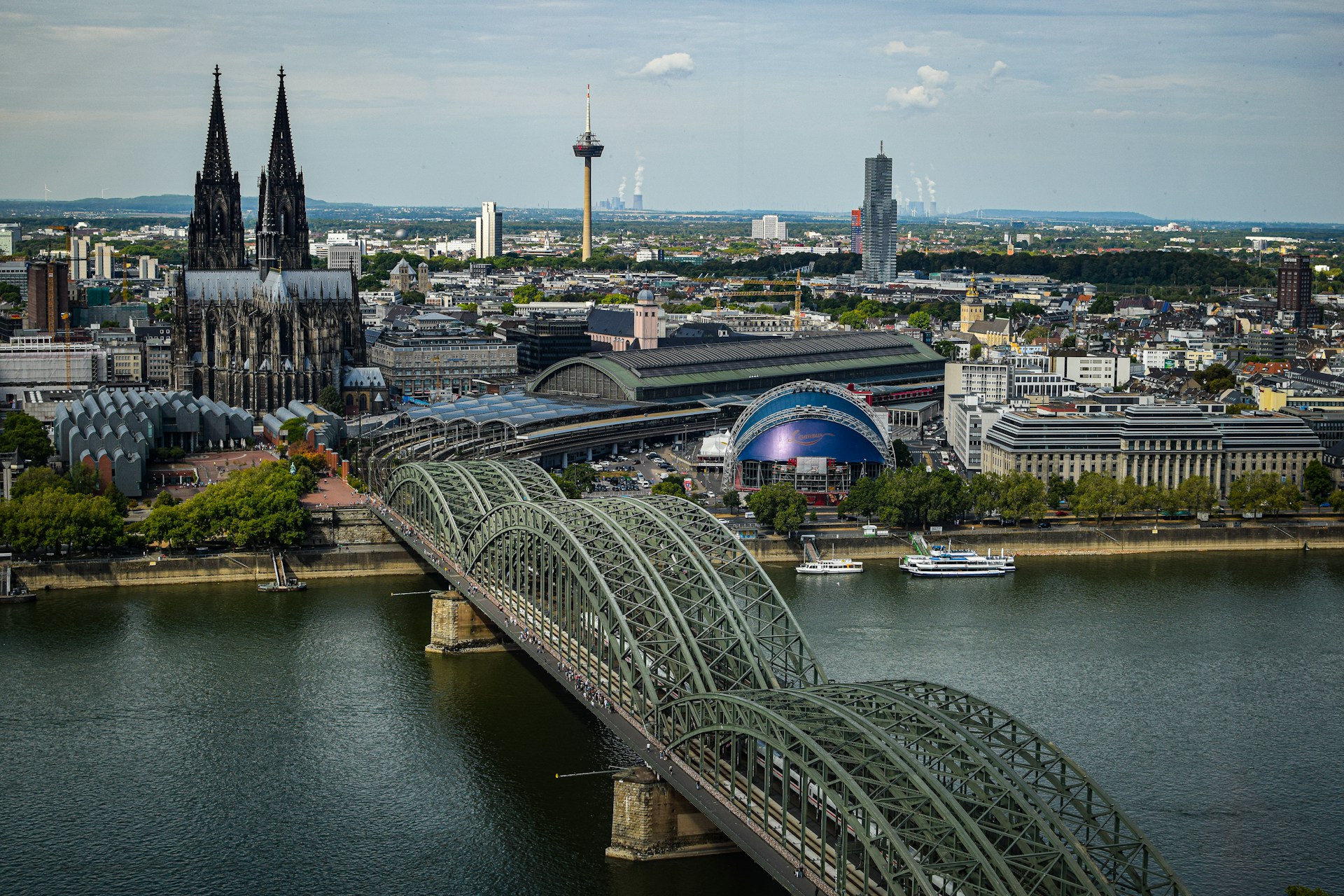
Cologne (Köln) is Germany's fourth-largest city and one of its most distinctly characterful. Sitting on the Rhine in North Rhine-Westphalia, it has been a major European settlement since Roman times — Colonia Claudia Ara Agrippinensium — and its 2,000-year history is still legible in the city's layout, its museums, and in the shadow of the Cologne Cathedral, one of the great Gothic structures in the world. But Cologne is emphatically not a museum city. It is a working, creative, commercially active place with a media industry of European significance, a substantial university population, and a population that takes its Karneval season with genuine seriousness.
For expats, Cologne sits in a useful middle ground. It is large enough to have the infrastructure, cultural life, and employment base of a major city, yet compact enough that most central neighbourhoods are within 20 minutes of each other by public transport or bike. It is significantly cheaper than Frankfurt or Munich, and moderately cheaper than Berlin for equivalent accommodation. The professional community is broad: media, automotive, chemical, insurance, logistics, and consulting firms all maintain significant presences here, and the University of Cologne brings a large and continuously renewing international academic population.
Wunderflats data for June 2025 to May 2026 shows that 48.3% of furnished-apartment tenants in Cologne arrive for work, with a further 18.2% studying and 21.5% covering a temporary housing need. The average stay runs to 155 days, just over 5 months, and 84% of bookings are for 3 months or longer. This is a city where people come to live, not just to pass through.
Key facts
Cologne is the largest city in North Rhine-Westphalia, Germany's most populous state. Its position on the Rhine makes it a natural logistics hub, and its central location in western Europe means it is within easy reach of Amsterdam, Brussels, Paris, and Frankfurt.
| Fact | Detail |
|---|---|
| Population | ~1.08 million (city); ~3.6 million (Rhine-Ruhr metro area) |
| Area | 405 km² — compact by German city standards |
| Official language | German. English widely spoken in media, tech, and international firms. |
| Climate | Temperate oceanic. Mild winters (avg. 3°C in Jan), warm summers (avg. 22°C in July). Wetter than Berlin; ~1,600 hours of sunshine per year. |
| Transport network | KVB Stadtbahn (U-Bahn + tram), S-Bahn regional rail, and bus network. Cologne Hauptbahnhof is a major ICE hub. |
| Key industries | Media and broadcasting, automotive, chemicals, insurance, logistics, retail, higher education |
| Typical furnished rental | 1,000–1,500 EUR/month most common (47.6% of bookings); average across all apartments 1,523 EUR/month. Source: Wunderflats internal data, Jun 2025–May 2026. |
| Average stay length | 155 days (~5 months). Source: Wunderflats internal data, Jun 2025–May 2026. |
Neighbourhoods
Cologne's relatively compact size means that neighbourhood choice affects daily atmosphere more than commute time. Most central districts are within 20 minutes of the Dom and Hauptbahnhof by Stadtbahn. The clearest distinction is between the left bank (Linksrheinisch) — home to most residential and commercial life — and the right bank (Rechtsrheinisch), which is quieter and somewhat cheaper.
Average rent per m² by neighbourhood (EUR/month, 2026)
Sources: Investropa Cologne Rent Analysis 2026; Immobilienscout24 Mietpreisspiegel Köln 2026
Innenstadt is the historic core, centred on the Cathedral, Hauptbahnhof, and the old town (Altstadt). It is the most expensive area and best suited to those who want maximum centrality and do not mind city-centre noise and tourist density. The surrounding Zülpicher Viertel and Friesenplatz areas are slightly more residential and popular with students.
Ehrenfeld is Cologne's Kreuzberg equivalent: formerly industrial, now home to independent restaurants, gallery spaces, recording studios, and a large Turkish and creative community. It has gentrified significantly over the past decade and is now one of the most sought-after areas for younger professionals. The Ehrenfeld Stadtbahn station makes central connections straightforward.
Lindenthal is the natural choice for expat families and academics. It borders the University of Cologne campus, has excellent schools, and offers a quieter residential atmosphere without being remote from the city centre. The neighbourhood has a high proportion of university staff and medical professionals.
Nippes sits north of the ring road and offers some of the best value in the inner city. The Wilhelmplatz market is a genuine local institution, and the neighbourhood has a village-like character within a city of over a million. It suits those on a tighter budget who still want to be within cycling distance of the centre.
Deutz and Mülheim on the right bank are the most affordable options for those willing to cross the Rhine. Deutz is directly opposite the Dom with excellent Stadtbahn connections, and the Cologne trade fair (Koelnmesse) is located here. Mülheim has a larger Turkish and Eastern European community and is priced accordingly lower.
Transport
Cologne's transport network is operated by KVB (Kölner Verkehrs-Betriebe) and covers the city with an integrated Stadtbahn (light rail and underground tram), bus, and S-Bahn regional rail network. The Cologne-Bonn S-Bahn connects the two cities in around 30 minutes. For most expats living in the inner city, a bike and the Deutschlandticket cover all daily transport needs.
| Ticket | Coverage | Price (2026) |
|---|---|---|
| Deutschlandticket | All local and regional public transport across Germany, including KVB and S-Bahn | 63 EUR/month |
| Single ticket (zone 1b) | Inner Cologne city zone — most KVB journeys | 3.30 EUR |
| Short trip (Kurzstrecke) | Up to 4 stops on any KVB service | 2.10 EUR |
| 24-hour ticket | Unlimited city-zone travel for one person | 9.40 EUR |
Cologne is one of Germany's most cycle-friendly cities. A network of dedicated cycle paths runs along both banks of the Rhine and connects most residential neighbourhoods to the centre. Bike sharing is available via KVB Rad and Nextbike. For intercity travel, Cologne Hauptbahnhof offers direct ICE connections to Frankfurt (approximately 1 hour), Berlin (approximately 4 hours), Brussels, Paris, and Amsterdam, making it one of the best-connected rail hubs in Germany.
ℹ Info: Cologne has two airports: Cologne/Bonn Airport (CGN) serves budget and regional routes; Düsseldorf International (DUS), around 45 minutes away by S-Bahn, handles the full range of long-haul connections. Most expats commuting internationally use DUS for intercontinental flights.
Cost of living
Cologne sits in the middle tier of German city costs — more expensive than Leipzig or Dresden, but comfortably below Frankfurt and Munich. A single expat living comfortably spends around 1,800–2,800 EUR/month. Rent is the dominant variable: furnished apartments in central Cologne run between 1,000 and 1,800 EUR/month for a typical 1-bedroom.
| Category | Monthly estimate | Notes |
|---|---|---|
| Furnished rent (1BR) | 900–1,700 EUR | Average across entire apartments on Wunderflats: 1,523 EUR/month. Most common range 1,000–1,500 EUR (47.6% of bookings). Source: Wunderflats internal data, Jun 2025–May 2026. |
| Groceries | 230–320 EUR | Comparable to Berlin. Aldi, Lidl, Rewe, and Edeka well distributed across all districts. |
| Public transport | 63 EUR | Deutschlandticket covers KVB, S-Bahn, and all regional transport including Cologne–Bonn. |
| Health insurance (employee) | ~200–450 EUR | Employees contribute ~7.3% of gross salary; employers match. Freelancers pay the full 14.6%. |
| Utilities (if not included) | 100–180 EUR | Most furnished rentals include utilities. Broadcasting fee (Rundfunkbeitrag): 18.36 EUR/household. |
| Dining out | 130–280 EUR | Cologne's restaurant scene spans from traditional Brauhäuser (beer halls) at 12–18 EUR to upscale dining at 40+ EUR. |
| Leisure and sport | 40–130 EUR | Gym memberships from 20 EUR/month. Cologne's Rhine promenade, parks, and cycling routes are free. |
Rental market breakdown by home type
Entire apartments account for 91% of Wunderflats bookings in Cologne, averaging 1,523 EUR/month. Private rooms are available at an average of 869 EUR/month — a practical option for students and shorter-term stays. The Cologne furnished rental market is noticeably cheaper on average than Berlin's (where equivalent entire apartments average 1,669 EUR/month), making it an attractive destination for budget-conscious professionals.
| Home type | Share of bookings | Avg monthly price |
|---|---|---|
| Entire apartment | 91% | 1,523 EUR |
| Private room | 7% | 869 EUR |
| Entire house | <2% | 2,623 EUR |
Source: Wunderflats internal data, Jun 2025–May 2026.
💡 Tip: Furnished apartments on Wunderflats typically include internet, often utilities, and always kitchen equipment and bedding. For expats on a 3–6 month assignment, the all-in furnished price is almost always lower than the combined cost of an unfurnished flat plus setup.
Healthcare
Cologne has strong healthcare provision, anchored by the University Hospital of Cologne (Uniklinik Köln), one of Germany's major academic medical centres with over 1,500 beds and specialist departments covering virtually all medical fields. For routine GP care and specialist access, the city's physician density is above the national average.
Physicians per 1,000 inhabitants
Source: Destatis / OECD Health at a Glance 2025. Figures are approximate.
Germany operates a dual health insurance system. Employees earning below the annual threshold (around 69,300 EUR in 2026) are automatically enrolled in statutory health insurance (gesetzliche Krankenversicherung, GKV). Contributions are around 14.6% of gross salary, shared equally between employer and employee. Freelancers pay the full contribution themselves, typically 200–450 EUR/month depending on income.
Finding an English-speaking GP in Cologne is straightforward, particularly in Lindenthal, Innenstadt, and Ehrenfeld. The online booking platform Doctolib is widely used for both GPs and specialists. The Uniklinik also runs international patient services for more complex medical needs.
Working life
Cologne is Germany's undisputed media capital. RTL Group, one of Europe's largest commercial broadcasters, is headquartered here, alongside WDR (the major public broadcaster for North Rhine-Westphalia), Deutsche Welle (Germany's international broadcaster), and a dense cluster of production companies, advertising agencies, and digital media firms. The city also hosts the Gamescom trade fair, reinforcing its position in the games and digital entertainment sector.
Beyond media, Cologne has significant depth in automotive (Ford Germany's headquarters has been in Cologne since 1930, and Toyota Germany is also based here), chemicals and industrial materials (Lanxess, spun off from Bayer, is headquartered in Cologne), insurance and financial services (AXA Germany, Generali Germany), and logistics. The University of Cologne, with around 50,000 students, is one of Germany's largest universities and generates a sustained flow of graduates and international researchers into the city's employer base.
Wunderflats data reflects this breadth: 48.3% of Cologne tenants arrive for work, with a high proportion of corporate-funded relocations (9.1% of bookings are employer-paid, compared to 6% in Berlin). The top tenant nationalities — Turkish (9.2%), American (5.8%), Indian (5.8%), French (5.2%), and Italian (4.3%) — reflect both the city's historic Turkish community and the international nature of its corporate employers.
Work culture in Cologne is more relaxed than in Frankfurt. The city's Rhineland character, known for its openness and sociability, tends to carry over into professional settings. English functions well as a working language across media, tech, and international firms; German remains essential in public-sector roles and smaller local employers.
Monthly booking demand in Cologne (net standard bookings, Jun 2025–May 2026)
Source: Wunderflats internal data, Jun 2025–May 2026. Standard bookings only.
Culture and leisure
Cologne's cultural life is shaped by two things above all: its Roman history and its Rhenish character. The city has over 40 museums, including the Romano-Germanic Museum (Römisch-Germanisches Museum), the Museum Ludwig (one of Europe's finest modern art collections), and the Wallraf-Richartz-Museum covering 700 years of European painting. Cologne Cathedral itself — a UNESCO World Heritage Site and 157 metres tall — dominates the skyline and remains the city's single most visited site.
Karneval is the other defining Cologne experience. The street carnival in the days before Ash Wednesday, peaking on Rosenmontag (Rose Monday), brings over a million people into the city. For expats arriving in Cologne, it is a genuine cultural initiation: the city stops functioning as normal for several days, and participation is not optional in the social sense. Embracing it rather than resisting it is strongly advised.
The Rhine promenade (Rheinuferpromenade) is one of the city's great outdoor assets: a wide riverside walkway used year-round for running, cycling, and summer drinking. Cologne's beer culture centres on Kölsch, a light, top-fermented beer served in small 200ml glasses at traditional Brauhäuser like Früh am Dom, Gaffel, and Päffgen. The beer garden and Brauhaus culture provides a ready-made social infrastructure for newcomers.
"Cologne has over 40 museums, a UNESCO World Heritage cathedral, and one of Europe's most celebrated street carnivals. For a city of one million, that is a remarkable concentration of cultural life."
Crime and safety
Cologne is a safe city for residents in its residential neighbourhoods. The overall crime rate is moderate for a German city of its size. The areas around Cologne Hauptbahnhof and the Dom square have elevated rates of pickpocketing and opportunistic theft, particularly during busy periods and Karneval. Residential districts — including Ehrenfeld, Nippes, Lindenthal, and the Südstadt — are consistently safe for daily life.
Recorded crimes per 100,000 inhabitants (approx., lower = safer)
Source: Polizeiliche Kriminalstatistik (PKS) 2025, Bundeskriminalamt. Figures are approximate and reflect total recorded offences including minor crimes. Higher urban rates reflect tourism concentration and density rather than elevated risk for residents.
Practical precautions for newcomers: use a quality bike lock (Cologne has high bicycle theft rates in common with most German cities), keep bags close around the Hauptbahnhof and Dom area, and be aware that Karneval period requires extra vigilance in crowded spaces. For residential life in any of the districts covered in this guide, Cologne presents no meaningful safety concerns beyond standard urban awareness.
Practical tips
The process of settling in Cologne follows the same sequence as any German city, with Anmeldung (registration) as the essential first step. Getting this done within the first two weeks opens up everything else.
Before you arrive
- Book furnished accommodation first: You need a registered address to complete Anmeldung. A furnished apartment booked via Wunderflats provides a confirmed move-in date and a valid address immediately on arrival.
- Check visa requirements: EU/EEA citizens do not need a visa. Non-EU nationals should verify their visa category at the German embassy before travel.
- Open a German bank account in advance: N26, Bunq, and Wise all offer accounts openable before arrival. Most Cologne landlords and employers expect a German IBAN.
- Note Karneval dates if relevant: The Karneval season runs roughly November to February with the main street event in the days before Ash Wednesday. Businesses close, transport is disrupted, and accommodation demand spikes. Factor this into arrival timing and apartment search.
On arrival
- Complete Anmeldung within 14 days: Book your appointment at the nearest Bürgeramt in advance — online slots fill quickly. You will receive your Meldebescheinigung immediately at the appointment.
- Get your Steuer-ID: Your tax identification number is sent by post to your registered address within a few weeks. Required for payroll and financial accounts.
- Register with a health insurer: Choose a statutory insurer (TK, AOK Rheinland, Barmer) and register as soon as you start work. Your employer's HR team will usually initiate this.
- Buy the Deutschlandticket: Available via the KVB app or your employer's job ticket portal. Covers all KVB, S-Bahn, and regional transport immediately.
Once settled
- Learn some basic German: The Kölner Volkshochschule (VHS) offers German courses from around 120 EUR per semester. The Rhenish dialect (Kölsch) is distinct but Germans across the city understand standard German perfectly.
- Get a KVB Rad card: The city bike-share scheme is well maintained and practical for short journeys. An annual card costs around 30 EUR.
- Explore Ehrenfeld on foot: The neighbourhood has a density of independent restaurants, bars, and cultural venues that repays slow exploration. The weekly Ehrenfelder Markt is a good starting point on Saturday mornings.
- Understand the waste system: Cologne has strict colour-coded recycling (Gelber Sack for packaging, Blaue Tonne for paper, Restmüll for residual waste, and Biotonne for organic waste). Your building's Hausmeister can clarify the local setup.
FAQs about living in Cologne
How much does it cost to live in Cologne per month?
A single expat living comfortably in Cologne typically spends between 1,800 and 2,800 EUR per month, including rent. Based on Wunderflats booking data (June 2025–May 2026), the most common furnished rental range is 1,000–1,500 EUR/month, with an average across entire apartments of 1,523 EUR/month.
What is the best neighbourhood in Cologne for expats?
It depends on your priorities. Ehrenfeld suits younger professionals and creatives well. Lindenthal is ideal for families and those near the University of Cologne. Nippes offers excellent value with a strong local character. The Innenstadt is most central but most expensive, and suits those who want maximum access to Cologne's transport and cultural core.
Is Cologne a good city for expats?
Yes. Cologne has a large and well-established international community, a strong English-speaking professional environment across media, tech, and corporate services, and a cost of living significantly lower than Frankfurt or Munich. The city is compact and easy to navigate, and the Rhineland social culture — open, sociable, direct — tends to make integration easier than in more formal German cities.
What industries are in Cologne?
Cologne is Germany's media capital, with RTL Group, WDR, Deutsche Welle, and a large production and digital media cluster. Beyond media: Ford Germany and Toyota Germany (automotive), Lanxess (chemicals), AXA Germany and Generali (insurance and financial services), and the University of Cologne (around 50,000 students, large research employer). Consulting, logistics, and retail (the REWE Group is headquartered here) complete the picture.
How long do expats typically stay in Cologne?
Based on Wunderflats booking data, the average furnished apartment stay in Cologne is 155 days — just over 5 months. 84% of bookings are for 3 months or longer, reflecting the city's strong demand from medium-term professional and academic movers rather than short-stay tourists or business travellers. Source: Wunderflats internal data, Jun 2025–May 2026.
Sources
- Wunderflats internal booking data, Cologne (Köln), June 2025–May 2026
- KVB — Tickets and prices (2026)
- Bundeskriminalamt — Police Crime Statistics (PKS) 2025
- OECD Health at a Glance 2025 — Physician density
- Numbeo — Cost of Living in Cologne, July 2026
- Investropa — Cologne Rent Analysis 2026
- Stadt Köln — Museums overview
- University Hospital of Cologne (Uniklinik Köln)