Last updated: . Reviewed by the WunderHub editorial team.
By Wunderflats Editorial Team · Reviewed for accuracy
Key takeaways
- Marseille is approximately 49% cheaper than Paris on rent and around 30% cheaper overall: one of the best value major cities in France (Numbeo / Expatistan, 2026).
- A furnished one-bedroom in a central or coastal neighbourhood costs 900–1,600 EUR per month, depending on area.
- The city has the flattest demand curve in the Wunderflats network: only a 13-percentage-point spread between peak (August) and trough (February), reflecting year-round attractiveness.
- CMA CGM, the world's third-largest container shipping group, is headquartered in Marseille, anchoring a major port economy alongside Airbus Helicopters and a growing tech scene.
- The AP-HM university hospital system covers Marseille with four major hospitals. Register with CPAM and designate a médecin traitant within your first few weeks.
- Safety varies sharply by district. Central and coastal arrondissements (1st–8th) are substantially safer than the northern areas, and the overall city crime trend is improving: down 4.1% year-on-year in 2024.
Quick answer
Marseille is France's oldest city and its most affordable major one. Rent runs around 49% cheaper than Paris. The port economy, growing tech scene, and year-round Mediterranean climate make it a compelling base for expats in logistics, maritime, and tech. Central and coastal districts are safe and well-connected by the RTM metro and tram network.
Overview: France's oldest city, and its most misunderstood
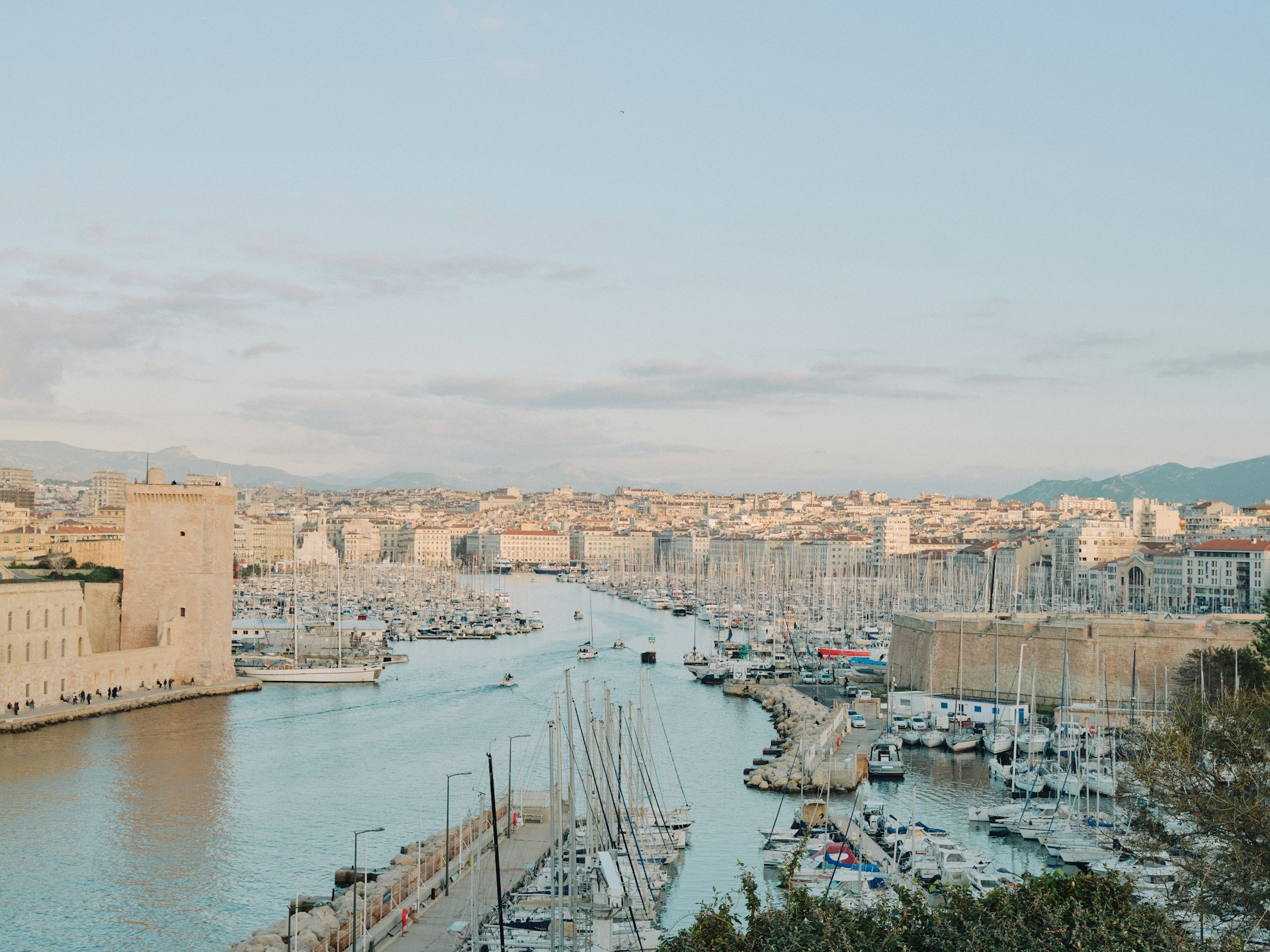
Founded by Greek sailors from Phocaea around 600 BCE, Marseille is the oldest continuously inhabited city in France. It sits on the Mediterranean coast in the Provence-Alpes-Côte d'Azur (PACA) region, roughly 775 km south of Paris, and looks out across the Gulf of Lion toward North Africa and the islands of Corsica and Sardinia. This maritime orientation is not merely historical: the Port de Marseille-Fos is France's largest port and the second busiest in the Mediterranean, and the city's entire economic and cultural identity is shaped by its role as a crossroads between Europe, Africa, and the Middle East.
For years, Marseille carried a reputation shaped more by tabloid headlines than by the experience of the roughly 870,000 people who live there. That reputation is changing. A decade of sustained urban investment, the 2013 European Capital of Culture year, and the opening of the MuCEM museum complex on the seafront have shifted how the city presents itself to the world. International professionals, artists, and remote workers are arriving in growing numbers, drawn by the combination of affordable housing, a strong university ecosystem, and a quality of life that Paris simply cannot offer at similar cost.
None of this means Marseille is problem-free. Social inequality is visible, certain northern districts face real challenges, and the rental market in desirable central areas is competitive. But for expats who approach it with clear eyes, Marseille offers something rare: a genuinely cosmopolitan Mediterranean city where the budget stretches far, the sun is near-constant, and the food is exceptional. This guide covers everything you need to make the move confidently.
"For expats who approach it with clear eyes, Marseille offers something rare: a genuinely cosmopolitan Mediterranean city where the budget stretches far, the sun is near-constant, and the food is exceptional."
Key facts
| Category | Detail |
|---|---|
| Official name | Marseille |
| Region | Provence-Alpes-Côte d'Azur (PACA) |
| Department | Bouches-du-Rhône (13) |
| Population | ~870,000 (city); ~1.76 million (Aix-Marseille-Provence métropole) |
| Area | 240.6 km² (city proper; France's largest city by area) |
| Language | French; significant Arabic, Comorian, and Italian-heritage communities |
| Climate | Hot-summer Mediterranean (Csa); 300+ days of sunshine; Mistral wind in winter |
| Average temperature | Jan 8°C / Jul 26°C |
| Transport | 2 metro lines, 2 tram lines, city bus network (RTM); Gare Saint-Charles (TGV); ferry port |
| Key industries | Maritime / shipping, logistics, energy, aerospace, tech, higher education, tourism |
| Major employers | CMA CGM, Airbus Helicopters, Port de Marseille-Fos, ArcelorMittal, Thales, Orange |
| Universities | Aix-Marseille Université (~80,000 students, one of Europe's largest); KEDGE Business School |
| Airport | Marseille Provence Airport (MRS), ~25 km northwest; served by all major European carriers |
Neighbourhoods: where expats live in Marseille
Marseille is divided into 16 arrondissements. For expats, the relevant choices are almost entirely in the 1st through 8th arrondissements and along the southern coastal strip. The northern arrondissements (13th–16th) are largely residential suburbs with higher crime rates; they are best avoided until you know the city well.
One thing that surprises many newcomers: Marseille is France's largest city by surface area (240 km²), meaning the spread between districts feels significant. A flat in the 8th near Prado beach and a flat in the 2nd near the Vieux-Port are both "central" on a map but feel like different cities in character and pace. Choosing the right neighbourhood matters more here than in most French cities.
Rent data below is sourced from local market aggregators (Investropa, Morning Croissant, Ibanista, Uniplaces, 2025–2026) and reflects furnished one-bedroom apartments suitable for mid-term expat stays.
Furnished 1-bed rent by neighbourhood, Marseille (mid-range estimate, EUR/month, 2026)
Source: Investropa, Morning Croissant, Ibanista, Uniplaces (2025–2026). Mid-range estimates for furnished 1-bed apartments; actual prices vary by size, condition, and floor.
Prado / Périer (8th arrondissement)
The 8th is Marseille's most sought-after address for expat professionals and international families. Quiet, tree-lined streets run down to the Prado beaches, Marseille's main sandy beach area, and the neighbourhood has a relaxed, residential feel entirely at odds with the frenetic Vieux-Port. Furnished one-beds typically run 1,300–1,600 EUR per month. International schools, private clinics, and high-end supermarkets are all within easy reach. Commute to the city centre takes around 20 minutes by metro (line M2) or bus.
Endoume / Roucas-Blanc (7th arrondissement)
A hillside neighbourhood between the Vieux-Port and the Corniche Kennedy coastal road, Endoume feels more like a Provençal village than part of a major city. Sea views are common, the streets are narrow and shaded, and the daily market on Place Castellane draws locals rather than tourists. Expat families with children tend to settle here. Rent runs 1,100–1,500 EUR for a furnished one-bed; larger family apartments are available but command a significant premium given the limited housing stock. The 83 bus and Castellane metro station (M1/M2) connect it to the rest of the city efficiently.
Vieux-Port area (1st and 2nd arrondissements)
Living next to the old harbour places you at the geographic and social heart of Marseille. The waterfront is lined with restaurants and bars, the ferry to the Frioul islands leaves from here, and virtually every bus and metro line converges nearby. Furnished one-beds cost 900–1,400 EUR. It is noisier and busier than the southern neighbourhoods, but the trade-off is unbeatable walkability: MuCEM, the Panier, Saint-Charles station, and the city's main shopping streets are all within 15 minutes on foot.
Le Panier (2nd arrondissement)
The oldest part of Marseille, settled since Greek colonial times, Le Panier is a dense warren of steep lanes, colourful facades, and small squares. Artists, designers, and younger expats are the primary draw. Apartments are often characterful but small and sometimes poorly maintained; inspect carefully. Furnished one-beds run 800–1,200 EUR. The neighbourhood sits directly above the Vieux-Port and has no metro stop of its own, though it is walkable from several.
Cours Julien / La Plaine (6th arrondissement)
Marseille's creative quarter. Street art covers nearly every surface, independent record shops and bookstores line the streets, and the twice-weekly market on Place Jean-Jaurès is a genuine neighbourhood institution. It attracts students, young professionals, and anyone who values affordability over quiet. Furnished one-beds cost 700–950 EUR, the lowest of any central option. Metro line M1 (Notre-Dame du Mont stop) connects it to the rest of the city in minutes.
Tip: Marseille's furnished rental market for mid-term stays (1–12 months) is smaller than in Paris or Lyon. Search early: ideally 8–10 weeks before your intended arrival date if you plan to move between June and September.
Getting around Marseille
The Régie des Transports Métropolitains (RTM) operates Marseille's public transport network. Two metro lines (M1 and M2), two tram lines (T2 and T3), and an extensive bus network cover the central and southern arrondissements well. Coverage becomes patchier in outer northern districts, where car ownership is higher.
One detail worth knowing: Germany's Deutschland-Ticket does not apply in France. If you are moving from a German city, budget separately for your Marseille transport costs from day one.
| Mode | Detail | Cost (approx.) |
|---|---|---|
| Métro (M1 and M2) | 2 lines, 29 stations; covers Vieux-Port, Saint-Charles, Castellane, La Rose, La Fourragère | Included in RTM pass |
| Tram (T2 and T3) | T2: Arenc to Blancarde; T3: Arenc to Les Caillols | Included in RTM pass |
| Bus network | Extensive city and suburban routes; complements metro and tram gaps | Included in RTM pass |
| RTM monthly pass | Carte Mensuelle RTM (city zone), all modes | ~57–63 EUR/month |
| Vélo+ bike-sharing | 150+ docking stations; electric bikes available at select stations | ~25–30 EUR/year (annual pass) |
| TGV from Gare Saint-Charles | Paris: 3h10 min / Lyon: 1h45 min / Aix-en-Provence TGV: 12 min | From ~25–80 EUR (Paris); varies by timing and class |
| Ferry (Joliette terminal) | Corsica, Sardinia, Tunisia, Algeria; operated by La Méridionale, Corsica Linea, CTN, Algérie Ferries | Varies by destination and season |
| Car | Useful for Calanques access, out-of-town trips, northern districts; not essential for central living | Parking 50–120 EUR/month (central); fuel at French average |
Info: Marseille has good road connections to the rest of France via the A7 (northward), A50 (eastward toward Toulon), and A55 (westward toward Aix and the Camargue). Car ownership is more common here than in Paris, but for central living it is a convenience rather than a necessity.
Cost of living in Marseille
Marseille is one of France's most affordable major cities, and the gap with Paris is substantial. Rent alone is approximately 49% cheaper than the capital; total living costs run roughly 30% lower. For expats arriving from other French cities, the comparison is still favourable: Marseille typically undercuts both Lyon and Bordeaux in the mid-range bracket, and dramatically undercuts Nice for comparable coastal living.
The figures below are based on Numbeo, Expatistan, and Expatica data for 2026 and reflect a single person in a furnished central apartment. Costs for couples or families scale but do not double proportionally: groceries, utilities, and transport are shared expenses.
| Expense | Monthly cost (EUR) | Notes |
|---|---|---|
| Furnished 1-bed (central) | 900–1,400 EUR | Higher in 7th–8th; lower in 6th |
| Utilities (electricity, heating, water) | 80–150 EUR | Lower than northern France due to mild climate; summer cooling can push costs up |
| RTM monthly transport pass | ~60 EUR | City zone, all modes |
| Groceries | 250–300 EUR | Markets (Noailles, Cours Julien) offer excellent value on fresh produce |
| Dining out | 100–180 EUR | Lunch menus (formule midi) at 12–16 EUR are common near business districts |
| Mutuelle (complementary health) | 50–100 EUR | Covers the 30% not reimbursed by Assurance Maladie; often partly employer-paid |
| Mobile phone | 15–30 EUR | Free, Bouygues, and SFR all compete aggressively on price |
| Total estimate (single person) | 1,400–2,200 EUR | Excludes savings, leisure, travel |
Info: Marseille does not currently apply the same strict rent control (encadrement des loyers) that Paris and Lyon have introduced. Landlords can set rents more freely, which means negotiating is possible, particularly on longer mid-term contracts.
Healthcare in Marseille
France uses the Assurance Maladie system (Sécurité Sociale) rather than the German GKV or PKV model. The key entry point is PUMA (Protection Universelle Maladie), which covers all residents legally living in France from their first day of employment or legal residency. Registration with the CPAM (Caisse Primaire d'Assurance Maladie du Bouches-du-Rhône) is the practical first step: expect 4–8 weeks to receive your Numéro de Sécurité Sociale (NIR) and then your carte Vitale health card.
Once registered, you must designate a médecin traitant (a GP you see first for all non-emergency care) to access the standard reimbursement rate of 70% of approved fees. Most people add a mutuelle (complementary insurance) to cover the remaining 30%, costing approximately 50–100 EUR per month. Employers are legally required to contribute at least 50% of their employees' mutuelle costs, which effectively reduces the out-of-pocket cost significantly for salaried workers.
Physicians per 1,000 inhabitants: PACA vs other regions (DREES, 2024 estimates)
Source: DREES (Direction de la recherche, des études, de l'évaluation et des statistiques), données 2024. Note: France's national physician density (3.4/1,000) is substantially lower than Germany's (5.2/1,000, Destatis 2023). PACA region sits above the French average, benefiting from the AP-HM university hospital system.
Marseille benefits from the AP-HM (Assistance Publique Hôpitaux de Marseille), one of France's largest university hospital systems. It operates four major hospitals: La Timone (general and specialist care), Nord, Conception, and Sainte-Marguerite. La Timone hosts a major paediatric and maternity unit. Emergency departments (urgences) are open 24 hours; for non-emergencies, always see your médecin traitant first to avoid reduced reimbursement rates.
Private clinics are plentiful in the 8th and 13th arrondissements. Many GPs in central Marseille are "secteur 2" (allowing additional fees above the standard rate), so check with CPAM before your first appointment to understand what your mutuelle covers beyond the base 70%.
Working life in Marseille
Marseille's economy is anchored by the Port de Marseille-Fos: France's largest port and the second busiest in the Mediterranean. The port alone handles over 80 million tonnes of freight annually, supporting a deep ecosystem of logistics, shipping, energy, and industrial companies across the Fos-sur-Mer industrial zone to the west. CMA CGM, the world's third-largest container shipping group, has its global headquarters in central Marseille, making the city an international hub for maritime professionals.
Aerospace is the second major pillar. Airbus Helicopters operates its main manufacturing and design facility in Marignane, approximately 20 minutes from central Marseille, employing around 10,000 people. Thales, ArcelorMittal, and energy companies including TotalEnergies have significant regional presences. Orange maintains a regional headquarters in the city.
A growing tech and startup ecosystem has developed around La CIOSM (Cité de l'Innovation et des Savoirs à Marseille) and several Station F-affiliated incubators. This is still smaller in scale than Paris or Lyon's tech clusters, but activity is accelerating: Marseille ranked among France's top five cities for tech startup creation in recent years. For remote workers, coworking space is plentiful and cheap relative to Paris.
Monthly listing demand in Marseille (standard bookings, Jun 2025–May 2026)
Source: Wunderflats internal platform data, Jun 2025–May 2026 (Marseille). Standard bookings only. Bars show relative demand indexed to August (peak = 100%). Absolute volumes not published. Note: Wunderflats operates a growing but relatively small volume in Marseille compared to major German cities; the trend reflects platform activity and should be read as directional.
What this demand curve reveals is striking: Marseille has the flattest seasonal profile in the Wunderflats network. The gap between peak (August, 100%) and trough (February, 87%) is only 13 percentage points. Compare that to cities like Berlin or Munich, where the summer-winter spread can exceed 40 points. The implication for anyone searching for furnished accommodation is practical: there is no "quiet season" to exploit in Marseille. Demand stays consistently high across all 12 months, and competition for good mid-term apartments is year-round.
Aix-Marseille Université (AMU), with roughly 80,000 enrolled students, is one of the largest universities in Europe by headcount. KEDGE Business School runs an English-taught MBA programme here. For international researchers, academics, and students, this creates a substantial English-speaking professional network that is larger than the city's reputation might suggest.
Culture and leisure: what Marseille is really like to live in
The best way to understand Marseille's cultural life is to stop comparing it to Paris. It operates on different logic: more Mediterranean, more African and Middle Eastern in influence, more focused on the outdoor and the spontaneous than on the institutional and the curated. Sunday morning at the Noailles market, where spices, olives, North African pastries, and fresh fish compete for space, gives a better sense of how this city actually feels than any museum.
That said, the institutional offer is genuinely impressive. MuCEM (Musée des Civilisations de l'Europe et de la Méditerranée), which opened in 2013 as the centrepiece of the European Capital of Culture year, has become one of France's most visited museums. Its location on the J4 pier, connected to the Fort Saint-Jean by a suspended footbridge, is one of the most dramatic settings of any museum in the country. The FRAC Sud collection and La Friche la Belle de Mai (a vast multi-arts cultural factory in a former tobacco factory) anchor a lively contemporary arts scene.
Outdoors, the Calanques national park is Marseille's defining natural asset: a 20 km stretch of limestone cliffs, turquoise inlets, and garrigue scrubland that begins at the city's southern edge and runs toward Cassis. You can reach the nearest calanques (En-Vau, Port-Pin) by boat from the Vieux-Port in 45 minutes, or hike in from the Luminy campus. The park is strictly managed: entry is restricted on high fire-risk days between June and September. On the right morning it is genuinely extraordinary.
The Stade Vélodrome (Olympique de Marseille, capacity 67,000) is not merely a football stadium: it is the loudest and most consistently passionate football atmosphere in France, and attending an OM match is one of the authentic Marseillais experiences. For day trips: Aix-en-Provence is 30 minutes by car or bus, Arles and the Camargue wetlands are 90 minutes, and Avignon is under two hours.
Crime and safety
Marseille's crime reputation precedes it, and a factual assessment is more useful than either dismissal or alarm. Recorded offences in 2024 totalled approximately 100,829 for a population of around 870,000, equivalent to roughly 11,590 per 100,000 inhabitants (Ministère de l'Intérieur, données enregistrées 2024). That is higher than the French national average. The chart below shows the comparison with other major French cities.
Info: French crime statistics (crimes, délits, and contraventions enregistrés by police and gendarmerie) use a broader scope than German PKS statistics, which cover only crimes and major offences. The figures below are French cities only; cross-country comparisons should be treated with caution.
Recorded offences per 100,000 inhabitants, major French cities (2024)
Source: Ministère de l'Intérieur, données enregistrées par les forces de l'ordre 2024; ville-data.com. Lower values indicate safer conditions. Note: Paris figure reflects the higher crime density of a very large, high-density metropolitan area.
Two context points matter here. First, the trend is improving: overall recorded acts in Marseille fell 4.1% year-on-year in 2024, and the hypercentre (1st–7th arrondissements) saw a 12.7% decline in general delinquency in 2025 vs 2024. Second, crime is heavily concentrated geographically. The northern arrondissements (13th–16th) account for a disproportionate share of serious incidents; the central and coastal districts (1st–8th) are substantially safer and comparable in day-to-day feel to other major French cities.
For expats living and working in the areas covered elsewhere in this guide (Prado, Endoume, the Vieux-Port, Le Panier, Cours Julien), standard urban precautions apply. Stay aware of your surroundings in crowded areas. Avoid walking alone through unfamiliar northern districts at night. Keep valuables secure on public transport. None of this is specific to Marseille; it applies equally to Paris, Lyon, or any major European city.
Practical tips for moving to Marseille
Before you arrive
- Secure housing early: Marseille has year-round demand for furnished mid-term apartments. Start your search 8–10 weeks before arrival, especially for summer moves. Platforms like Wunderflats list fully furnished options with flexible lease terms suited to international relocations.
- Prepare your documents: French landlords typically require proof of income (3 months of payslips or a work contract), a guarantor or caution solidaire, and passport or residence permit copies. Having everything scanned and ready speeds up the process significantly.
- Research your arrondissement: The 16 arrondissements vary enormously in character, price, and safety. Use the neighbourhood section of this guide to narrow your search to 1st–8th before looking at listings.
- Check your visa requirements: EU nationals can live and work in France freely. Non-EU nationals must apply for a visa (visa de long séjour) before arriving; the type depends on your employment status. Apply at least 2–3 months before your intended start date through the French consulate in your home country.
- Open a French bank account: Many online banks (Revolut, Wise, N26) can be opened before you arrive and accept a foreign address. Traditional French banks (BNP Paribas, Crédit Agricole, Société Générale) require proof of French address but offer broader services. A bank account is required to set up direct debits for rent and utilities.
On arrival
- Register with CPAM: Contact the Caisse Primaire d'Assurance Maladie du Bouches-du-Rhône (cpam.fr) within the first two weeks of arrival. You will need your passport, proof of address, and employment contract or student card. Processing takes 4–8 weeks.
- Designate a médecin traitant: Once you have your Numéro de Sécurité Sociale, find a local GP (check Doctolib.fr for available doctors taking new patients) and register them as your médecin traitant. This is required to receive standard 70% reimbursements.
- Get an RTM monthly pass: Available at Gare Saint-Charles and all metro ticket offices. Bring proof of address for the discounted rates if you qualify (students, under-26, job seekers).
- Register your address: France does not require a formal Anmeldung-style address registration. However, you will need a utility bill or a landlord's attestation de domicile to open a bank account, register with CPAM, and access most administrative services.
- Apply for a titre de séjour (non-EU nationals only): Non-EU nationals must apply for a residence permit within 3 months of arrival via the ANEF (Administration Numérique des Etrangers en France) online portal. Start immediately on arrival to avoid administrative delays.
Once settled
- Join an expat or professional network: InterNations Marseille, the British Consulate network, and industry-specific groups (especially in maritime and logistics) are active. AMU's international student office runs regular events for newly arrived academics.
- Take a French language course: English is less widely spoken in Marseille than in Paris. Basic French makes daily life significantly easier and is expected in administrative contexts. Alliance Française Marseille (alliancefrancaise-marseille.com) offers all levels including intensive formats suited to new arrivals.
- Explore the city systematically: Marseille rewards effort. The first impression of any neighbourhood rarely captures the full picture. Give yourself 3–6 months before judging which areas you prefer; many expats find the city grows on them considerably over the first year.
- Plan your Calanques visits for spring and autumn: The national park restricts access to many entry points during July and August on high fire-risk days (risque incendie). April to June and September to October offer the best balance of good weather and unrestricted access.
FAQs about living in Marseille
Is Marseille a good city for expats?
Marseille is an excellent city for expats who value affordability, sunshine, and cultural richness. It is France's second-largest city by population and its oldest, a major port and logistics hub, and home to one of Europe's largest universities (Aix-Marseille Université, ~80,000 students). Cost of living runs approximately 49% cheaper on rent and around 30% cheaper overall than Paris, while the Mediterranean climate delivers over 300 days of sunshine annually.
The city's international workforce is concentrated in maritime, logistics, aerospace, and growing tech sectors. CMA CGM, the world's third-largest container shipping group, has its global headquarters here, and Airbus Helicopters operates its main facility in nearby Marignane. For professionals in these fields, Marseille is one of the few places in France where industry depth and cost of living align favourably.
English is less widely spoken than in Paris, and some northern districts carry well-documented safety concerns. However, the central and coastal arrondissements (1st–8th) are safe, walkable, and increasingly popular with international professionals and families seeking a high quality of life at manageable cost. Most long-term expats describe the city as having a steep but rewarding learning curve.
Is Marseille expensive?
Marseille is one of France's most affordable major cities. A single person can live comfortably on a monthly budget of 1,400–2,200 EUR, including a furnished one-bedroom apartment (900–1,400 EUR in central areas), utilities (80–150 EUR), an RTM monthly transport pass (~60 EUR), groceries (250–300 EUR), dining out (100–180 EUR), and a complementary health mutuelle (50–100 EUR). Mobile phone plans start from 15 EUR per month with operators like Free or Bouygues.
Rent is approximately 49% cheaper than Paris and around 30% lower overall (Numbeo / Expatistan, 2026). Compared to Lyon, Bordeaux, or Nice, Marseille tends to be cheaper in the mid-range bracket, particularly for larger apartments and anything near the coast.
Food is a genuine advantage: the Noailles market and Cours Julien market offer fresh produce, fish, and North African ingredients at prices well below supermarket rates. Dining out at local restaurants (not tourist-facing Vieux-Port terraces) is also excellent value: a two-course lunch formule in the business district typically costs 12–16 EUR including a drink. The main budget risk is housing: good furnished apartments in the 7th and 8th arrondissements go quickly and command prices at the upper end of the range.
What are the safest and best neighbourhoods for expats in Marseille?
The safest and most popular neighbourhoods for expats are Prado and Périer (8th arrondissement), Endoume and Roucas-Blanc (7th arrondissement), and the Vieux-Port area (1st and 2nd arrondissements). Each has a distinct character and price point.
Prado and Périer offer quiet, upscale living near the Prado beaches, with good schools, private clinics, and easy metro access to the centre. Furnished one-beds run 1,300–1,600 EUR per month. Endoume and Roucas-Blanc attract expat families with sea views, narrow village streets, and a calm pace; expect 1,100–1,500 EUR. The Vieux-Port area places you at the centre of everything: historic harbour, restaurants, transport. Expect 900–1,400 EUR, with more noise and foot traffic as the trade-off.
Le Panier (2nd) is the artistic, bohemian option at 800–1,200 EUR: beautiful but inspect carefully for building condition. Cours Julien and La Plaine (6th) are the most affordable at 700–950 EUR, with a young, creative energy. Northern arrondissements (13th–16th) are generally not recommended for expats new to the city, due to higher recorded crime rates and more limited transport connections to central Marseille.
Is Marseille safe?
Safety in Marseille depends heavily on location and context. Recorded offences in 2024 totalled approximately 11,590 per 100,000 inhabitants city-wide (Ministère de l'Intérieur, 2024), higher than the French national average of around 5,800 per 100,000. However, this figure requires careful interpretation.
The overall crime trend is improving: total recorded acts fell 4.1% year-on-year in 2024, and the hypercentre (1st–7th arrondissements) saw a 12.7% decline in general delinquency in 2025 compared with 2024. Crime is concentrated geographically in the northern arrondissements (13th–16th), which most expats have no routine reason to visit. The central and coastal districts, where most expats live and work, are substantially safer and feel comparable to other major French cities in day-to-day experience.
Standard urban precautions apply everywhere: stay aware of your surroundings in crowded areas such as La Canebière and public transport during peak hours, keep valuables secure, and avoid unfamiliar northern areas at night. Marseille is not a city to fear: millions of people live, work, and raise families here safely. Approach it with the same attentiveness you would bring to any large European city.
How do I get around Marseille without a car?
Marseille is very navigable without a car if you live in the central or southern arrondissements. The RTM network operates two metro lines (M1 and M2), two tram lines (T2 and T3), and an extensive bus network covering most of the city. A monthly pass (Carte Mensuelle RTM) costs approximately 57–63 EUR for the city zone and covers all modes. Buy it at any metro station ticket office or at Gare Saint-Charles.
The Vélo+ bike-sharing scheme has over 150 docking stations across the city, including electric bikes at selected locations. An annual subscription costs around 25–30 EUR. For short trips within the centre, cycling is often faster than the metro.
For longer-distance travel, Gare Saint-Charles (a 10-minute metro ride from the Vieux-Port) offers TGV services to Paris (3h10 min), Lyon (1h45 min), and Aix-en-Provence TGV station (12 minutes). Note that Germany's Deutschland-Ticket does not apply in France: if you are coming from a German city, you will need to budget for RTM passes separately. A car becomes genuinely useful for accessing the Calanques national park, out-of-town shopping, and day trips to Arles or the Camargue. For central daily life it is optional rather than necessary.
How do I register with the French healthcare system in Marseille?
France uses the Assurance Maladie system (Sécurité Sociale), which covers all residents legally in France under PUMA (Protection Universelle Maladie). This is not the same as Germany's GKV or PKV system: there is no choice between public and private insurers at the foundational level.
The registration process has four steps. First, contact the CPAM (Caisse Primaire d'Assurance Maladie du Bouches-du-Rhône) at cpam.fr and submit your application with proof of identity (passport or EU ID), proof of French address (lease agreement or utility bill), and employment contract or student card. Processing takes 4–8 weeks. Second, you will receive your Numéro de Sécurité Sociale (NIR), a unique 15-digit identifier. Third, request your carte Vitale, the green health card you present at every medical appointment. Fourth, register a médecin traitant (GP) via Doctolib.fr or directly at a GP practice: this is required to receive the standard 70% reimbursement of approved medical fees.
Most salaried workers also have a mutuelle (complementary insurance) through their employer, which covers the remaining 30% of approved fees. Employers are legally required to contribute at least 50% of mutuelle costs. If your employer does not provide one, private mutuelles are available from around 50–100 EUR per month. Marseille's AP-HM university hospital system has four major hospitals (La Timone, Nord, Conception, Sainte-Marguerite) for specialist and emergency care. For non-emergencies, always see your médecin traitant first to avoid reduced reimbursement rates.
Sources
- Wunderflats internal platform data, Jun 2025–May 2026 (Marseille)
- Ministère de l'Intérieur: données enregistrées par les forces de l'ordre (2024)
- Ville-data.com: Criminalité à Marseille (2024)
- DREES: Statistiques annuelles des médecins en France (données 2024)
- Assurance Maladie (CPAM Bouches-du-Rhône): registration information
- RTM (Régie des Transports Métropolitains): Titres et tarifs 2026
- Numbeo: Cost of living in Marseille (2026)
- Expatistan: Cost of living in Marseille (2026)
- Investropa: Neighbourhoods in Marseille (2025–2026)
- AP-HM (Assistance Publique Hôpitaux de Marseille): hospital network overview
- Aix-Marseille Université: official website