Last updated: . Reviewed by the WunderHub editorial team. Rental price data sourced from Wunderflats bookings, June 2025–May 2026.
Key takeaways
- The average monthly rent on Wunderflats in Hamburg is 1,634 EUR, with a median of 1,500 EUR: meaningfully below Munich but above the German average (Jun 2025–May 2026).
- The most common price tier is 1,000–1,500 EUR per month (38.6% of bookings), offering more accessible entry points than Germany's most expensive cities.
- 56.7% of Wunderflats tenants book for work purposes, reflecting Hamburg's position as a major corporate and logistics hub.
- Hamburg has 8.0 physicians per 1,000 inhabitants: the highest density of any German federal state (Bundesärztekammer, Dec 2024).
- The Deutschland-Ticket (63 EUR/month) covers the full HVV network, including U-Bahn, S-Bahn, bus, and harbour ferry: no car needed.
- You must complete Anmeldung at your district Kundenzentrum within 14 days of moving in. This unlocks your tax ID and German bank account.
Quick answer
Hamburg is Germany's second-largest city and a global trade hub with a strong job market, world-class healthcare, and a well-connected public transport network. Wunderflats data (Jun 2025–May 2026) shows the median monthly rent for a furnished apartment is 1,500 EUR: well below Munich, with the largest share of bookings between 1,000 and 1,500 EUR.
Overview
Germany's second-largest city sits on the Elbe river about 100 km from the North Sea, and its identity has always been shaped by that proximity to open water. Hamburg became one of Europe's most powerful trading cities in the medieval Hanseatic League and has never lost that mercantile confidence. Today it is home to Europe's third-largest container port, the European headquarters of Airbus, and a media industry that produced Der Spiegel, Die Zeit, and Stern: all from the same postcode. That combination of global commerce and cultural output makes Hamburg unusually diverse for a northern European city.
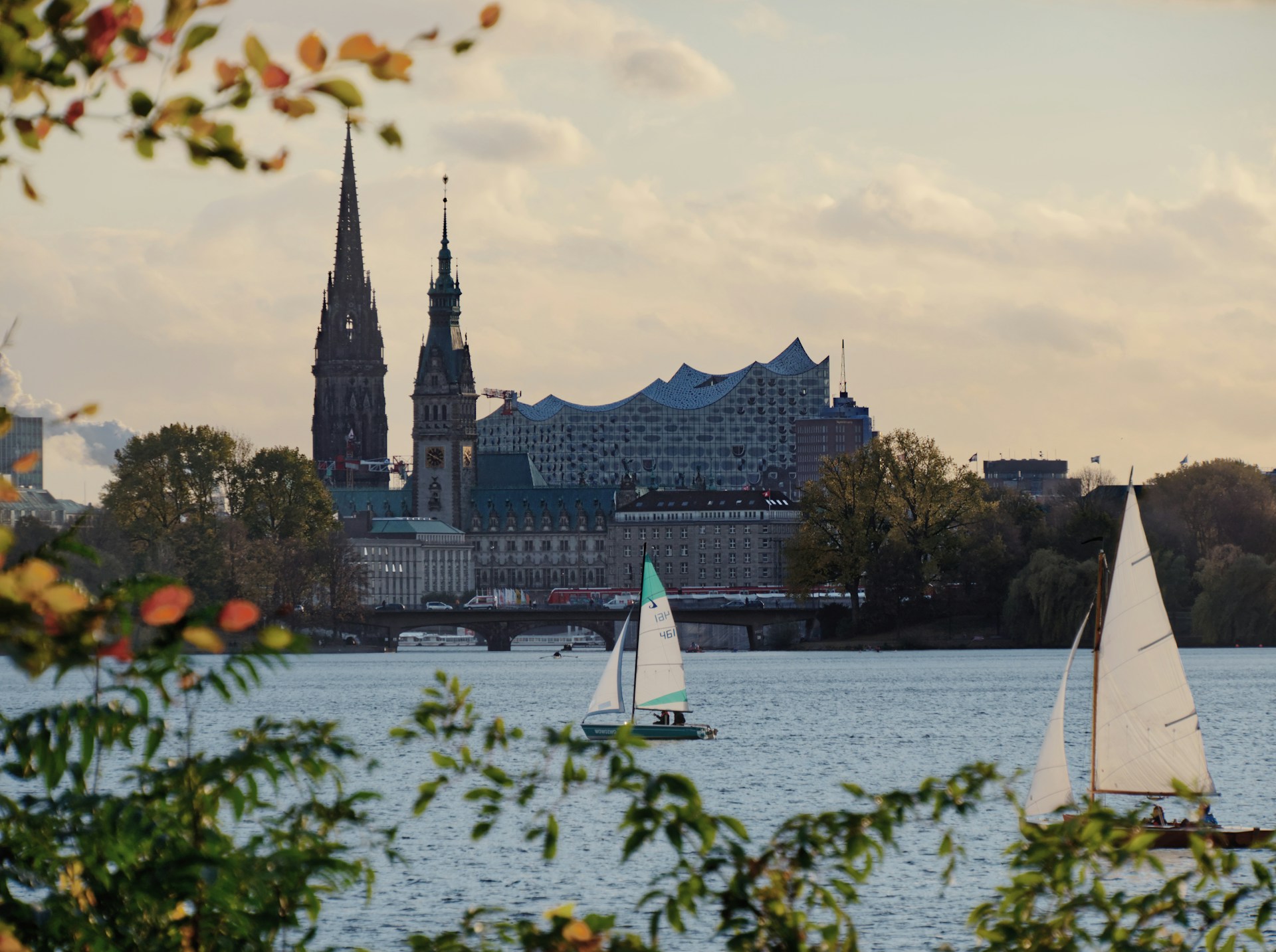
With around 1.9 million inhabitants in the city proper and nearly 3 million in the wider metropolitan area, Hamburg is both compact enough to feel navigable and large enough to offer the full range of urban amenities. The city-state status (Hamburg is simultaneously a city and a federal state) gives it a degree of administrative independence that translates into well-funded schools, excellent healthcare infrastructure, and a public transport system that receives consistent investment. The Alster lakes sit at the heart of the city, providing a stretch of open water for sailing, rowing, and running that very few European capitals can match.
For expats, Hamburg offers a genuinely welcoming environment. The city has centuries of experience with international traders, seafarers, and settlers: and that openness persists today. English is widely spoken in professional contexts, several international schools serve families, and the HafenCity neighbourhood represents one of Europe's most ambitious urban development projects, attracting international architects, businesses, and residents. Rents are high by German standards but remain below Munich or central Zurich, and the quality of life return on those costs is strong. This guide covers the city district by district, from the numbers you need before signing a lease to the practical steps for your first weeks on the ground.
"Hamburg has centuries of experience with international traders, seafarers, and settlers: and that openness persists today."
Key facts
| Category | Detail |
|---|---|
| Official name | Freie und Hansestadt Hamburg (Free and Hanseatic City of Hamburg) |
| Status | City-state (one of three German city-states alongside Berlin and Bremen) |
| Population | ~1.9 million (city); ~3 million (metro area) |
| Area | 755 km² |
| Language | German; English widely spoken in business and international contexts |
| Climate | Temperate maritime; mild summers (avg 18–22°C in Jul), cool winters (avg 1–5°C in Jan); moderate rainfall year-round |
| Transport system | HVV: 4 U-Bahn lines, S-Bahn, extensive bus network, harbour ferry (Fähre) |
| Airport | Hamburg Airport (HAM); S1 line, ~25 min to Hauptbahnhof |
| Key industries | Logistics and shipping, aerospace (Airbus), media, e-commerce, finance, life sciences |
| Notable employers | Airbus, Beiersdorf, Hapag-Lloyd, Otto Group, Aurubis, XING/New Work SE, About You, Zeit Group, Statista |
| Universities | Universität Hamburg, HAW Hamburg, HafenCity Universität, HSBA Hamburg School of Business Administration |
| Time zone | CET (UTC+1); CEST (UTC+2) in summer |
Neighbourhoods
Hamburg divides into seven administrative districts (Bezirke), each subdivided into smaller quarters with distinct characters. Choosing the right area depends on your work location, budget, and lifestyle. The neighbourhoods below cover the main areas relevant to expats and international professionals, from the waterfront modernity of HafenCity to the more affordable streets of Barmbek-Nord.
The chart below shows average monthly rents by borough (Bezirk) in Hamburg, based on Wunderflats booking data from June 2025 to May 2026 (standard furnished apartment bookings, 28 days or more). Each borough covers multiple neighbourhoods, so prices within a borough vary by street and property type.
Average monthly rent by borough, Hamburg (Wunderflats bookings, Jun 2025–May 2026)
Source: Wunderflats internal data, Jun 2025–May 2026. Standard bookings only. Average monthly rent by borough (Bezirk).
HafenCity
Built on former port warehousing land south of the old city centre, HafenCity is one of Europe's largest inner-city development projects and has been under construction since the early 2000s. It now combines residential towers, creative offices, the Elbphilharmonie concert hall, and direct access to the UNESCO World Heritage Speicherstadt warehouse district. Living here means modern, high-spec apartments, views over the Elbe, and a five-minute walk to the city centre. The trade-off is rent: expect approximately 2,000 EUR per month for a one-bedroom furnished apartment, and a neighbourhood that is still maturing its street-level retail and community character.
HafenCity is particularly well suited to professionals who work in the port, logistics, or consulting sectors, or anyone whose company is headquartered nearby. The U4 line connects it to the city centre in minutes.
Eppendorf
North of the Alster, Eppendorf is Hamburg's most consistently desirable residential neighbourhood. Its streets are lined with Gründerzeit townhouses, independent cafes, and a weekly market that locals treat as a social institution. The University Medical Centre (UKE) is a major local employer, and the neighbourhood is popular with doctors, academics, and established professionals. Rents are around 1,800 EUR per month for a furnished one-bedroom, reflecting both the quality of the housing stock and the area's enduring appeal. Eppendorf has a village-like calm that belies its central location: the Hauptbahnhof is less than 20 minutes by U3.
Eimsbüttel
Eimsbüttel is consistently one of the most popular areas for young professionals and international residents. It sits immediately west of the city centre, is served well by the U2 and U3 lines, and offers a lively mix of independent restaurants, concept stores, and tree-lined streets. Average rents in the Eimsbüttel borough run around 1,796 EUR per month (Wunderflats data, Jun 2025–May 2026), with a median of 1,600 EUR: higher than Altona and Hamburg-Nord, reflecting strong demand from professionals. The neighbourhood draws a broad demographic: students, creatives, young families, and corporate professionals all live side by side. Eimsbüttel is where many expats end up staying longer than they planned.
Altona
Altona was an independent city before it was incorporated into Hamburg in 1937, and that self-contained character persists. It has its own mainline rail station (Hamburg Altona), access to the Elbe beaches at Övelgönne, and the famous Altonaer Fischmarkt: a Sunday morning fish and flea market that starts at 5am and draws the city together across generations and backgrounds. Turkish, Portuguese, and other immigrant communities give Altona a genuine multicultural texture. Wunderflats booking data (Jun 2025–May 2026) puts the Altona borough average at 1,660 EUR per month, with a median of 1,575 EUR: competitive for a borough that includes direct Elbe access and its own mainline station.
Barmbek-Nord
Barmbek-Nord is Hamburg's most accessible central option by price, with rents around 1,150 EUR per month. The neighbourhood is served by the U3 ring line and has been improving steadily over the past decade as its proximity to the city centre has drawn investment. It suits expats on a tighter budget who still want a proper urban neighbourhood with good transport connections. The Alstertal shopping centre and Stadtpark are both nearby, and the area's brick warehouse conversions give it a character distinct from the Altbau streets further west.
Tip: Hamburg's Wohnungsgeberbestätigung (landlord confirmation form) is required for Anmeldung. Confirm with your landlord before signing that they will provide this document. Furnished apartment providers on Wunderflats include this as standard.
Transport
Hamburg's public transport network is operated by the Hamburger Verkehrsverbund (HVV) and covers the city and surrounding region comprehensively. Four U-Bahn (underground) lines and a shared S-Bahn network with Deutsche Bahn form the backbone, supported by an extensive bus network and a harbour ferry (Fähre) that connects the southern districts across the Elbe. The city is also one of Germany's most cycle-friendly, with an expanding network of dedicated lanes.
The Deutschland-Ticket at 63 EUR per month provides unlimited travel on all HVV services and on regional trains across Germany: an exceptional value proposition for anyone commuting or travelling regularly. Hamburg Airport (HAM) is reached directly by the S1 line in approximately 25 minutes from Hauptbahnhof, and the airport is included in the Deutschland-Ticket zone.
| Option | Coverage | Monthly cost | Best for |
|---|---|---|---|
| Deutschland-Ticket | All HVV services + all regional trains nationwide | 63 EUR | All residents; the default choice |
| HVV single tickets | Within selected HVV zones | From 1.80 EUR per journey | Occasional travellers |
| HVV day ticket | All zones, unlimited daily travel | ~9.60 EUR/day | Tourists or short-stay visitors |
| StadtRAD Hamburg | Public cycle hire at 230+ stations | From 4 EUR/month (basic) | Short cycle journeys, last-mile |
| Car ownership | Citywide; parking limited and costly in centre | 200–400 EUR/month total cost (parking, insurance, fuel) | Families or suburban commuters only |
Hamburg's U3 ring line is particularly useful for cross-city travel without passing through the centre. The Harbour ferry (line 62) between Landungsbrücken and Finkenwerder is a genuine commuter service used by Airbus employees: not just a tourist attraction. Plan your route using the HVV app, which integrates real-time departures, disruptions, and fare calculation.
Info: Hamburg Airport (HAM) is covered by the Deutschland-Ticket. There is no need to buy a separate airport transfer ticket if you already hold a monthly pass.
Cost of living
Hamburg is expensive by German standards, but it occupies a middle ground between Munich (Germany's priciest city) and mid-sized cities like Leipzig or Dortmund. Based on Wunderflats booking data covering 1,001 standard bookings (stays of 28 days or more) between June 2025 and May 2026, the average monthly rent for a furnished apartment in Hamburg was 1,634 EUR, with a median of 1,500 EUR. The most common price band was 1,000–1,500 EUR, accounting for 38.6% of all bookings.
The price distribution tells a useful story for newcomers planning their budget. Just under 12% of bookings fell below 1,000 EUR per month: these are typically studio apartments in outer districts. The mid-market (1,000–2,000 EUR) covers 70.4% of all bookings, encompassing well-located one- and two-bedroom furnished flats. Premium apartments above 2,500 EUR per month account for 7.9% of the total, concentrated in HafenCity and Eppendorf.
| Price tier | Share of bookings | Typical profile |
|---|---|---|
| Under 1,000 EUR/month | 11.9% | Studio or small 1-bed in outer districts |
| 1,000–1,500 EUR/month | 38.6% | 1-bed in Barmbek, Altona, or Eimsbüttel |
| 1,501–2,000 EUR/month | 31.8% | Well-located 1–2 bed, central neighbourhoods |
| 2,001–2,500 EUR/month | 9.9% | Larger or premium 2-bed, Eppendorf or HafenCity |
| Over 2,500 EUR/month | 7.9% | Premium apartments, waterfront, or large family flats |
Beyond rent, a single person living in Hamburg should budget for the items below. These figures are based on typical Hamburg costs in 2026; your actual spend will vary depending on lifestyle and neighbourhood.
| Category | Monthly estimate | Notes |
|---|---|---|
| Furnished apartment (1-bed) | 1,200–2,000 EUR | Median 1,500 EUR; depends on district and size |
| Utilities (electricity, water, internet) | 130–180 EUR | Often included in furnished apartment price |
| Transport (Deutschland-Ticket) | 63 EUR | Covers all HVV including airport S1 |
| Groceries | 280–340 EUR | REWE, Edeka, Lidl, Aldi widely available |
| Dining out | 120–200 EUR | Lunch menus (Mittagstisch) from ~10 EUR |
| Health insurance (GKV, employee) | ~17.5% of gross salary (employer pays ~half) | Mandatory for employees earning below the Versicherungspflichtgrenze |
| Mobile phone | 15–30 EUR | Telekom, Vodafone, O2, or budget MVNOs |
| Total monthly estimate (single person) | 1,800–2,700 EUR | Excludes health insurance contribution from salary |
Info: Hamburg's furnished apartment market is active year-round. Wunderflats booking data shows that 87.4% of tenants pay rent themselves, while 9.4% have costs covered by their employer: a relatively high employer-paid share reflecting the city's significant corporate relocation market.
Healthcare
Hamburg offers some of the best healthcare access in Germany. As a city-state with a strong public funding base, it has invested heavily in both hospital capacity and primary care. According to the Bundesärztekammer's 2024 physician statistics (as of 31 December 2024), Hamburg has 8.0 physicians per 1,000 inhabitants: the highest physician density of any German federal state, well above the national average of 5.2 per 1,000.
Physician density per 1,000 inhabitants (Bundesärztekammer, 31 Dec 2024)
Source: Bundesärztekammer, Ärztestatistik 31. December 2024. Values represent physicians per 1,000 inhabitants by federal state.
For new residents, the first step is enrolling in a statutory health insurance scheme (gesetzliche Krankenversicherung, GKV). Employees are automatically covered once their employer registers them. The contribution is approximately 17.5% of gross salary, split roughly equally between employer and employee. Major GKV providers with English-language support include TK (Techniker Krankenkasse) and DAK-Gesundheit. Self-employed residents and high earners may opt for private health insurance (PKV) instead.
Once insured, you can register with a Hausarzt (GP). Wait times in Hamburg are shorter than in many German cities precisely because of the high physician density. For specialist appointments, ask your GP for a Überweisung (referral): this avoids co-payment and ensures the appointment is covered by your GKV. Hamburgische Krankenhausgesellschaft represents the city's hospital network, which includes the Universitätsklinikum Hamburg-Eppendorf (UKE), one of Germany's leading research hospitals and a major employer in the Eppendorf district.
Tip: TK (Techniker Krankenkasse) provides much of its customer communication in English and has a dedicated expat support line. For newcomers unfamiliar with the German healthcare system, TK is often the most straightforward starting point.
Working life
Hamburg's economy is built on trade, logistics, aerospace, and media, with a growing technology and e-commerce layer. The Port of Hamburg handles over 130 million tonnes of cargo annually and serves as a gateway for goods flowing between Asia and Central Europe: which means an unusually large cluster of shipping, freight forwarding, and supply chain businesses call the city home. Hapag-Lloyd, one of the world's largest container shipping companies, is headquartered here. So is Airbus, whose Hamburg facilities assemble the A320 family and employ tens of thousands of engineers, technicians, and programme managers.
Media and publishing are distinctively Hamburg. Der Spiegel, Die Zeit, Stern, and a cluster of digital publishers including Statista all operate major newsrooms in the city, making it Germany's undisputed media capital. XING (now New Work SE) was founded in Hamburg and remains a significant technology employer. About You, one of Europe's fastest-growing fashion platforms, is another Hamburg native. The city also hosts Montblanc, Goodgame Studios, and a growing fintech sector centred on the HafenCity and Innenstadt districts.
Wunderflats booking data provides a direct window into the working patterns of people moving to Hamburg. Of the 1,001 standard bookings recorded between June 2025 and May 2026, 56.7% stated work as their purpose, 13.7% were studying, 6.5% were on internships, and 1.9% were serving apprenticeships. Together, work and work-adjacent purposes account for more than two-thirds of all Hamburg bookings. A further 9.4% of bookings were paid for by an employer: the highest employer-paid share among major Wunderflats cities: reflecting the strength of corporate relocation demand from logistics, aerospace, and consulting firms.
Monthly booking demand in Hamburg (net standard bookings, Jun 2025–May 2026)
Source: Wunderflats internal data, Jun 2025–May 2026. Standard bookings only. Bars show relative demand indexed to March (peak = 100%). Absolute volumes not published.
The monthly demand pattern reveals something specific about Hamburg's corporate relocation rhythm. The peak is in March, with January and the November–December period remaining exceptionally strong. Summer months (June–September) dip relative to spring: a pattern that reflects corporate Q1 onboarding cycles rather than tourism or student intake. Many companies start new international contracts in January or February, producing arrivals that then trigger March move-ins. This is useful knowledge for apartment seekers: January and February are busy months for furnished flat hunting in Hamburg, and booking early pays off.
Hamburg has a notably international workforce. Among Wunderflats tenants (Jun 2025–May 2026), German nationals represent 35.9% of bookings, followed by Indian nationals (7.3%), Turkish nationals (6.5%), American (4.9%), French (3.7%), Italian (3.1%), and Spanish (2.6%). Hamburg's Turkish community is one of the largest in Germany and is deeply embedded in the city's commercial and cultural life: particularly in Altona and Wilhelmsburg. English is the working language in many international companies, and it is entirely possible to navigate the first months professionally and daily without advanced German, though learning the language significantly expands social and career options.
Culture and leisure
Hamburg is a city that takes culture seriously and delivers it at scale. The Elbphilharmonie, opened in 2017 on the tip of HafenCity, is now one of the world's great concert halls and has transformed how Hamburg presents itself internationally. Designed by Herzog and de Meuron on the foundation of a former warehouse, it hosts the Hamburg Philharmoniker and an international programme that spans classical, jazz, and contemporary music. The public viewing platform (Plaza) on the 37th floor is free with a timed ticket and offers one of the best views of the harbour and city skyline.
The Speicherstadt: the historic red-brick warehouse district adjoining HafenCity: was awarded UNESCO World Heritage status in 2015. Its canal-threaded streets house museums, design agencies, and carpet dealers who have occupied the same warehouses for over a century. The Miniatur Wunderland, also in the Speicherstadt, is the world's largest model railway exhibition and draws over 1.5 million visitors a year, though it is genuinely worth the visit for adults too. The Hamburger Kunsthalle is one of Germany's largest and finest art museums, covering works from the medieval period through to the present.
Leisure in Hamburg is shaped by water. The inner and outer Alster lakes, sitting at the heart of the city, host sailing clubs, rowboats for hire, and a 7.5 km jogging path that locals use in all weathers. The Elbe beaches at Övelgönne in Altona are a genuine urban beach: pebbly, not sandy, but atmospheric and popular on summer evenings. Planten un Blomen, a large formal park near the Messe convention centre, is free to enter and features a Japanese garden and open-air concerts in summer.
Hamburg's entertainment geography is distinctive. The Reeperbahn in St Pauli is Europe's most famous entertainment district, concentrated in about 500 metres of bars, clubs, theatres, and music venues. It hosts the Reeperbahn Festival, one of Europe's leading music industry conferences, every September. For a different kind of weekly ritual, the Altonaer Fischmarkt runs every Sunday from 5am (7am in winter) along the Elbe. The Dom fair at Heiligengeistfeld takes place three times a year (spring, summer, and autumn) and is Hamburg's equivalent of a street carnival: free to enter, traditionally local in character.
Crime and safety
Hamburg is a safe city for daily life. The Polizei Hamburg Polizeiliche Kriminalstatistik (PKS) for 2024 recorded 11,775 reported offences per 100,000 inhabitants: a decline of nearly 5% from the previous year. This figure is higher than Munich (approximately 6,000) but lower than Frankfurt am Main (14,600) and Cologne (12,727). All four cities sit above the national German average of 7,062, which reflects the universal pattern of higher recorded crime rates in dense urban centres compared to rural areas.
Recorded offences per 100,000 inhabitants (2024 PKS data)
Source: Polizei Hamburg PKS 2024; Bundeskriminalamt PKS 2024. Lower values indicate safer conditions. City-level rates are not directly comparable to national averages due to population density and reporting differences.
Most of Hamburg's recorded crime is concentrated in specific contexts rather than spread evenly across the city. The Reeperbahn area in St Pauli has a higher incidence of theft and disorder, particularly at night and on weekends: this is well-understood by locals and is managed through a significant police presence. Pickpocketing around Hauptbahnhof is the most common issue affecting newcomers, as it is in most major German rail hubs. Residential neighbourhoods including Eppendorf, Eimsbüttel, Barmbek, and Blankenese are calm and well-maintained areas where street-level crime is uncommon.
For daily life, Hamburg feels safe. The city's streets are well-lit, public transport runs late into the night, and the social infrastructure is strong. The harbour ferry and S-Bahn are used around the clock by a wide demographic. Standard urban precautions apply: keep valuables secure in busy transit areas, lock your bicycle with a quality lock (bike theft is common across all German cities), and be aware of your surroundings in the immediate vicinity of Hauptbahnhof late at night.
Practical tips
The steps below cover the practical sequence for arriving and settling in Hamburg. Doing these in order avoids the most common delays newcomers encounter.
Before you arrive
- Book a furnished apartment in advance: Hamburg's rental market is competitive, particularly in January and February when corporate Q1 arrivals peak. Use Wunderflats to find verified furnished flats with flexible durations of 28 days or more.
- Confirm your Wohnungsgeberbestätigung: Ask your landlord to confirm they will provide this document before you sign. Without it, you cannot complete Anmeldung. All Wunderflats landlords are familiar with this requirement.
- Research your Kundenzentrum: Hamburg divides Anmeldung across district Kundenzentren rather than a single central office. Find the one for your district at hamburg.de and check current appointment availability: some districts are busier than others.
- Open a German bank account: N26 and Bunq offer app-based accounts you can open before or immediately after arrival without a physical branch visit. A German IBAN is needed to pay rent and set up direct debits.
- Download the HVV app: Set it up before you arrive so you can buy tickets and plan routes from day one. The Deutschland-Ticket can be purchased directly through the app.
On arrival
- Register (Anmeldung) within 14 days: Take your passport (or national ID for EU citizens) and your Wohnungsgeberbestätigung to your district Kundenzentrum. Registration is free. You will receive a Meldebestätigung (registration certificate) on the day: keep it: you will need it for multiple subsequent steps.
- Apply for your Steueridentifikationsnummer (tax ID): Your tax ID is issued automatically within a few weeks of Anmeldung and arrives by post. Your employer needs it to process your salary correctly. If it has not arrived after four weeks, contact the Bundeszentralamt für Steuern directly.
- Enrol in health insurance: Contact TK, DAK, or another GKV provider within your first week of employment. Your employer handles the registration process once you notify them of your chosen provider.
- Get the Deutschland-Ticket: 63 EUR per month for unlimited travel across all HVV services and regional trains nationwide. Purchase through the HVV app or directly from your GKV provider, who may offer a subsidised rate.
- Register with a Hausarzt (GP): Do this in your first weeks, not after you are unwell. Walk in and ask to register as a new patient (Neupatient). Practices in Eppendorf and Eimsbüttel often have English-speaking staff.
Once settled
- Attend the Altonaer Fischmarkt on a Sunday morning: It starts at 5am (7am in winter). It is Hamburg's best free introduction to the city's character and a genuine social experience, not a tourist set-piece.
- Explore Planten un Blomen: Hamburg's most accessible free park, centrally located, with a Japanese garden and seasonal open-air events. A useful anchor for your first weeks.
- Join a sports or cultural club (Verein): Hamburg has an extraordinary density of clubs covering sailing, football, rowing, choirs, and almost everything else. Joining one is the fastest route to genuine social integration beyond the expat network.
- Contact the Einwohner-Zentralamt for complex registration questions: If your Anmeldung situation is non-standard (for example, if you are registering without a permanent address initially), the Einwohner-Zentralamt handles the more complex cases that a district Kundenzentrum may refer on.
- Consider the Hamburg Card for your first weeks: If you are exploring the city before settling into a routine, the Hamburg Card offers unlimited HVV travel plus discounts on museums and attractions. Once you have a Deutschland-Ticket, the Hamburg Card becomes redundant for transport.
Frequently asked questions about living in Hamburg
Is Hamburg a good city for expats?
Yes. Hamburg is Germany's second-largest city and consistently ranks among Europe's most liveable urban environments. It offers a strong international job market across logistics, aerospace, media, e-commerce, and finance, combined with excellent public transport, high healthcare quality, and a cosmopolitan culture shaped by centuries of maritime trade. English is widely spoken in professional contexts, and the city has a well-established expat community with access to international schools, English-language social networks, and a range of furnished accommodation options.
Compared with Munich, Hamburg is more affordable in terms of both rent and general cost of living, while offering a comparable quality of infrastructure and a broader media and creative sector. Compared with Berlin, Hamburg is more compact, better organised, and has a more stable rental market: though it lacks Berlin's price point and counterculture edge. The city rewards those who take the time to learn some German and engage beyond the expat bubble: neighbourhood life in areas like Altona, Eimsbüttel, and Eppendorf is warm and well-networked once you are registered and settled in.
One honest caveat: Hamburg's weather is cool and frequently grey, with rainfall distributed across the year rather than concentrated in a single wet season. This suits some people well and surprises others who arrive expecting a sunnier northern Europe. The city itself compensates with an indoor cultural life: theatres, concert halls, museums, and excellent restaurants: that functions well in all seasons.
How much does it cost to rent a furnished apartment in Hamburg?
Based on Wunderflats booking data covering 1,001 standard bookings (stays of 28 days or more) between June 2025 and May 2026, the average monthly rent for a furnished apartment in Hamburg was 1,634 EUR, with a median of 1,500 EUR. The most common price range was 1,000–1,500 EUR per month, accounting for 38.6% of all bookings. A further 31.8% of bookings fell in the 1,501–2,000 EUR range.
At the lower end of the market, 11.9% of bookings were below 1,000 EUR per month: typically studio apartments or smaller flats in outer districts such as Barmbek-Nord or Wandsbek. At the upper end, 9.9% of bookings were between 2,001 and 2,500 EUR, and 7.9% were above 2,500 EUR, concentrated in premium locations such as HafenCity, Eppendorf, and the Innenstadt.
These figures reflect furnished apartments with all-inclusive pricing. The average stay on Wunderflats in Hamburg was 159.3 days: approximately five months: which suggests that most tenants are not on short tourist stays but are committing to extended periods of work, study, or relocation. For anyone planning a medium-term move, booking in advance (particularly for January and March arrivals, which are peak months) reduces both cost and availability risk.
What is the best neighbourhood in Hamburg for expats?
The right neighbourhood depends on your priorities. Eimsbüttel and Altona are consistently the most popular choices for young professionals and international residents: both offer lively streets, independent restaurants and cafes, good U-Bahn connections, and a mixed demographic that includes long-term locals alongside newcomers. Altona has the added benefit of its own mainline rail station and direct access to the Elbe riverbank. Based on Wunderflats booking data (Jun 2025–May 2026), the Eimsbüttel borough averages 1,796 EUR per month and Altona averages 1,660 EUR, with medians of 1,600 EUR and 1,575 EUR respectively.
Eppendorf is the choice for those who want a quieter, more established residential atmosphere. Its streets are calmer, the housing stock is predominantly prewar townhouses, and the Alster is nearby for running and cycling. It is particularly popular with medical professionals and academics given the proximity of the UKE hospital and Universität Hamburg. Expect rents around 1,800 EUR per month.
HafenCity suits professionals who want modern, high-spec accommodation with direct harbour views and proximity to the city centre. It is especially practical if your employer is based in the port cluster or in the Innenstadt. Rents here are the highest in Hamburg at approximately 2,000 EUR per month for a one-bedroom. For those on a tighter budget, Barmbek-Nord offers a genuine central option at around 1,150 EUR per month, with the U3 ring line connecting it across the city.
Do I need a car in Hamburg?
No. Hamburg's HVV network covers the city comprehensively through four U-Bahn lines, a shared S-Bahn network with Deutsche Bahn, an extensive bus network, and a harbour ferry (Fähre) that connects south of the Elbe. The Deutschland-Ticket at 63 EUR per month provides unlimited access to all HVV services and to regional trains across all of Germany: an exceptional value for both daily commuting and weekend travel. Hamburg Airport (HAM) is served by the S1 line, reaching Hauptbahnhof in approximately 25 minutes, and this journey is included in the Deutschland-Ticket.
Parking in central Hamburg is expensive and limited. Residents in popular neighbourhoods like Eimsbüttel, Altona, and Eppendorf often find that owning a car creates more friction than it resolves: permit zones restrict street parking, and underground spaces in residential buildings can cost 100–200 EUR per month on top of rent. Car ownership makes most sense for families who need to travel outside the city regularly, or for professionals based at out-of-city sites like Airbus in Finkenwerder or Hamburg Airport in Fuhlsbüttel: though even Finkenwerder is served by the harbour ferry on weekdays.
For short-term or flexible car use, Hamburg has an established car-sharing market with providers including Stadtmobil, Miles, and Sixt Share. Cycling is also viable as a daily commute mode: the city has invested significantly in cycling infrastructure, and StadtRAD Hamburg's public bike hire scheme covers 230 stations across the urban area.
How do I register in Hamburg after moving?
Registration (Anmeldung) is legally required within 14 days of moving into your Hamburg apartment. The process takes place at the Kundenzentrum for your district: Hamburg does not have a single central registration office, so you go to the office serving your neighbourhood. You can find your local Kundenzentrum and book an appointment at hamburg.de. Appointment availability varies by district: in popular areas like Altona and Eimsbüttel, bookings can fill several weeks in advance, so arrange this as soon as you have a move-in date.
You will need two documents: your passport (or national identity card for EU citizens) and a Wohnungsgeberbestätigung: a written confirmation from your landlord confirming that you live at the address. This form is a legal requirement under German tenancy law (Bundesmeldegesetz), and your landlord is obliged to provide it. All furnished apartment providers on Wunderflats include this document as standard. Without it, the Kundenzentrum cannot complete your registration.
Registration is free and takes approximately 15–20 minutes at the counter. You receive a Meldebestätigung (registration certificate) immediately. This document then unlocks several subsequent steps: your Steueridentifikationsnummer (tax ID) is posted to your registered address within a few weeks automatically; your employer needs your tax ID to process your salary; most German banks require the Meldebestätigung before opening a current account. For complex registration situations: for example, if you are registering without a permanent address initially: the Einwohner-Zentralamt handles exceptional cases beyond the scope of a district Kundenzentrum.
Is Hamburg safe?
Hamburg is a safe city by European standards. The Polizei Hamburg Polizeiliche Kriminalstatistik (PKS) for 2024 recorded 11,775 offences per 100,000 inhabitants: a decline of nearly 5% from the previous year, continuing a multi-year downward trend in recorded crime. This figure is lower than Frankfurt am Main (14,600) and Cologne (12,727), though higher than Munich (approximately 6,000). The national German average is 7,062, and the gap between Hamburg and that figure largely reflects the universal pattern of higher recorded crime rates in dense urban centres.
For daily life as a resident, the picture is reassuring. Residential neighbourhoods across the city: Eppendorf, Eimsbüttel, Barmbek, Blankenese, Altona, and HafenCity: are calm and well-maintained, with street-level crime uncommon in everyday routines. Public transport is used safely by a wide cross-section of Hamburg residents at all hours, and the HVV network is well-staffed and well-lit. The most common issue affecting newcomers is petty theft around Hauptbahnhof and in very crowded transit situations: standard urban precautions (keeping bags in front, avoiding phones in crowded areas) are sufficient.
The Reeperbahn district in St Pauli sees concentrated nightlife-related activity, including higher rates of theft and disorder, particularly on Friday and Saturday nights. This is a well-known and well-managed area: police presence is significant, and it does not affect the character of the residential streets nearby. Wilhelmsburg, an island district south of the Elbe, is more economically mixed and occasionally features in crime statistics at a disproportionate level, but it too is undergoing significant regeneration investment. Overall, Hamburg presents no significant safety concerns for expats settling in established residential areas.
Sources
- Wunderflats internal booking data, Hamburg, June 2025–May 2026. Standard bookings (28+ days), aggregated and anonymised.
- Bundesärztekammer, Ärztestatistik 31. Dezember 2024. Physician density by federal state.
- Polizei Hamburg, Polizeiliche Kriminalstatistik (PKS) 2024. Offences per 100,000 inhabitants.
- Bundeskriminalamt, Polizeiliche Kriminalstatistik 2024. National average offences per 100,000 inhabitants.
- Hamburger Verkehrsverbund (HVV), Deutschland-Ticket pricing and coverage, 2025.
- Freie und Hansestadt Hamburg, Kundenzentren: Anmeldung bei einem Kundenzentrum.
- Bundesmeldegesetz (BMG), registration requirements and Wohnungsgeberbestätigung obligation.
- Elbphilharmonie Hamburg, venue and programme information.
- Speicherstadt Hamburg, UNESCO World Heritage Site information.