Last updated: . Reviewed by the WunderHub editorial team. Rental price data sourced from Wunderflats bookings, June 2025–May 2026.
Key takeaways
- Düsseldorf ranks #6 globally for quality of living (Mercer 2023) and has the largest Japanese community in continental Europe, shaping everything from the restaurant scene to its international business culture.
- Based on Wunderflats booking data (June 2025–May 2026), the most common furnished rental range is 1,000–1,500 EUR/month (47.5% of bookings), with an average apartment price of 1,420 EUR/month, lower than Berlin or Munich.
- 58.0% of Wunderflats tenants in Düsseldorf arrive for work. This is the highest work-driven share of any city in the Wunderflats network. The city draws professionals from Germany (34%), Turkey (8.3%), India (5.1%), and France (4.2%).
- The average Wunderflats stay in Düsseldorf is 132 days (around 4.3 months), shorter than Berlin or Cologne, consistent with project-based corporate assignments and trade-fair-driven secondments.
- The Rheinbahn network covers the city efficiently, and the Deutschlandticket at 63 EUR/month covers all public transport including S-Bahn to the airport in 11 minutes.
- Anmeldung (resident registration) is legally required within 14 days of moving in. It unlocks your bank account, health insurance, and most official services.
Overview
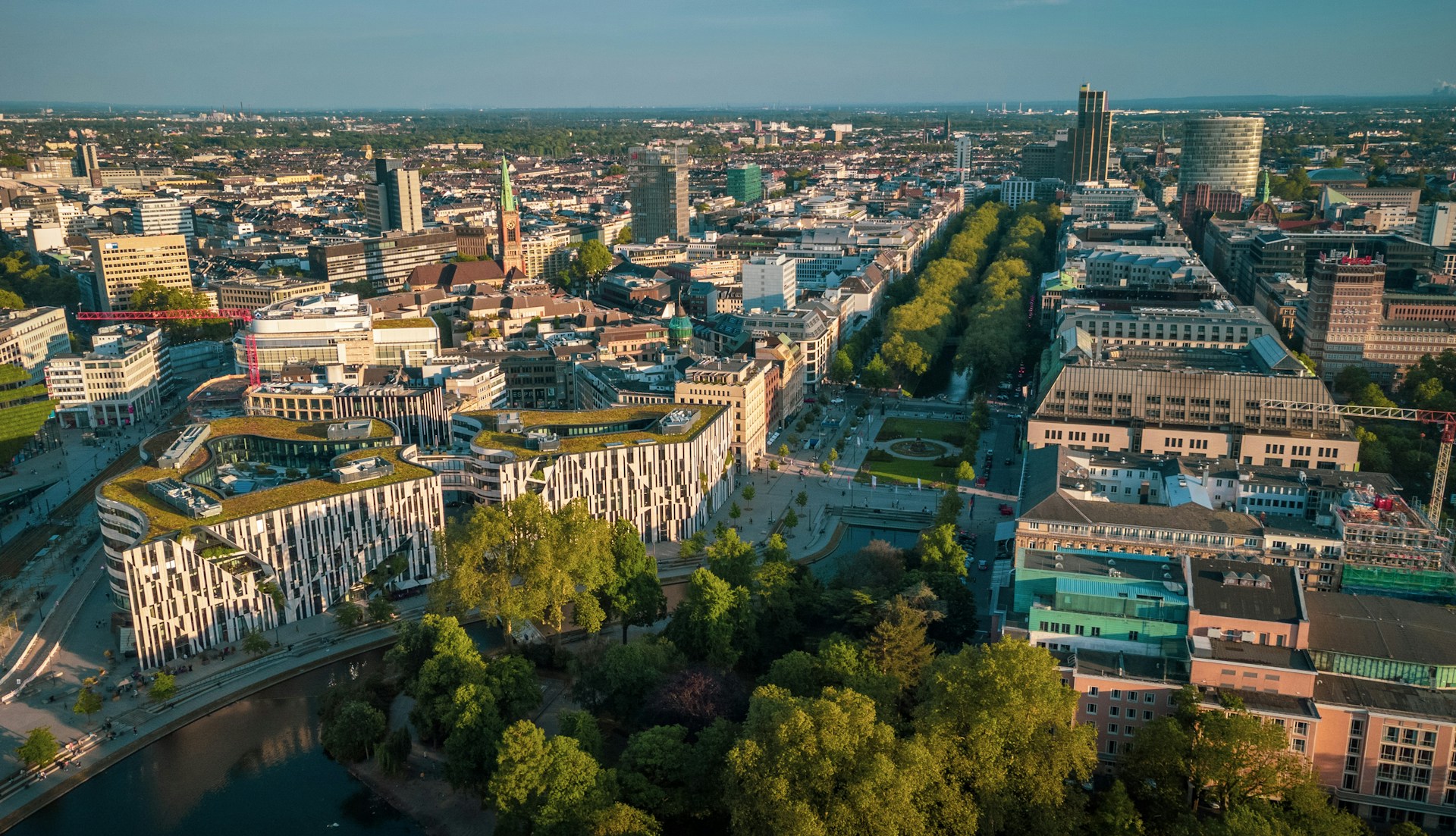
Düsseldorf sits on the Rhine in the heart of North Rhine-Westphalia, surrounded by one of the densest urban networks in Europe. It is the state capital of NRW, home to around 645,000 people, and the commercial and cultural centre of a metropolitan area that reaches some 10 million. The city is known internationally for its fashion trade fairs, its strong financial sector, and an art scene that punches well above its weight for a city of its size. It is also home to the largest Japanese community in continental Europe. This shapes everything from the restaurant scene to the annual Japan Day celebration on the Rhine promenade.
For incoming expats, Düsseldorf offers something that larger German cities often struggle to provide: genuine international infrastructure alongside manageable scale. The city is compact enough to navigate without a car, English is widely used in corporate settings, and the housing market is competitive but considerably more accessible than Munich or central Berlin. Mercer ranked Düsseldorf sixth in the world for quality of living in 2023, ahead of every other German city except Munich and Frankfurt.
Wunderflats data covering June 2025 to May 2026 shows that 58.0% of furnished-apartment tenants in Düsseldorf are here for work, the highest work-driven share in the Wunderflats network. A further 21.2% cite temporary housing needs, often reflecting relocation between roles or project-based assignments, and 9.3% are students. The average stay runs to 132 days, around 4.3 months, shorter than Berlin or Cologne, which is consistent with the city's prevalence of trade-fair-driven and secondment demand.
This guide is written for people moving to Düsseldorf or planning to, and draws on Wunderflats' first-party booking data alongside verified public sources to give an accurate picture of what the city actually costs, where to live, and how the practical systems work. Source: Wunderflats internal data, Jun 2025–May 2026.
Key facts
Düsseldorf is the capital of North Rhine-Westphalia, Germany's most populous state. Its position on the Rhine and proximity to the Ruhr area make it a natural gateway for companies operating across western and central Europe.
| Fact | Detail |
|---|---|
| Population | ~645,000 (city); ~10M (Rhine-Ruhr metro area) |
| Area | 217 km² |
| State | North Rhine-Westphalia (NRW) |
| Official language | German. English widely spoken in finance, tech, and international firms. |
| Climate | Temperate oceanic. Mild winters (avg. 1°C in Jan), warm summers (avg. 24°C in July). ~1,600 hours of sunshine per year. |
| Transport network | Rheinbahn U-Bahn, tram, and bus network plus S-Bahn regional rail. Airport (DUS) 11 min by S-Bahn. |
| Key industries | Fashion/trade fairs, financial services, telecoms, energy, advertising, medtech, retail |
| Quality of living | Ranked 6th globally (Mercer Quality of Living, 2023) |
| Typical furnished rental | 1,000–1,500 EUR/month most common (47.5% of bookings); average across all apartments 1,420 EUR/month. Source: Wunderflats internal data, Jun 2025–May 2026. |
| Average stay length | 132 days (~4.3 months). Source: Wunderflats internal data, Jun 2025–May 2026. |
Neighbourhoods
Düsseldorf's districts vary considerably in character and price. The clearest division is between the city centre neighbourhoods east of the Rhine (ranging from the expensive Altstadt to more affordable Flingern and Bilk) and the premium residential areas west across the river in Oberkassel and Niederkassel. Understanding where each neighbourhood sits helps narrow the search quickly.
Average rent per m² by neighbourhood (EUR/month, 2026)
Sources: Investropa Düsseldorf Rent Analysis 2026; Immobilienscout24 Mietpreisspiegel Düsseldorf 2026
Altstadt and Stadtmitte form the historic and commercial core of Düsseldorf. The Königsallee shopping boulevard, the Rhine promenade, and the dense Altstadt bar strip (known locally as the "longest bar in the world") all converge here. Living here places you at the centre of everything but at a premium: rents run 16–22 EUR/sqm and nightlife noise is a trade-off. Stadtmitte, just inland, offers better value with good transport links and a more residential feel.
Pempelfort is consistently the most popular neighbourhood for young professionals and expats arriving for mid-term assignments. It sits just north of the city centre and offers a good mix of cafés, restaurants, and green spaces along the Nordpark. Rents average 13–17 EUR/sqm. The area has excellent tram and U-Bahn connections and a relaxed but lively atmosphere. Many corporate housing providers place newly arrived employees here.
Oberkassel, across the Rhine to the west, is Düsseldorf's most sought-after residential address. Tree-lined streets, high-quality Wilhelminian-era housing, and direct Rhine views make it a natural choice for senior professionals and families. Rents start at 16–18 EUR/sqm and can exceed 25 EUR/sqm for premium riverside apartments. The bridge across to the Altstadt takes five minutes on foot. It is quieter and more family-oriented than the areas east of the Rhine.
Derendorf lies north of Pempelfort and is one of the city's more dynamic neighbourhoods, home to a growing tech and startup scene around the d.hub innovation district. Rents average 12–15 EUR/sqm, making it good value by Düsseldorf standards. The area has direct access to the trade fair grounds (Messe Düsseldorf) and the city centre, and a younger professional demographic has shaped a café culture along the main streets.
Flingern has transitioned from a working-class neighbourhood to one of the city's most creative quarters over the past decade. Independent coffee shops, vintage stores, and design studios characterise the main streets. Rents of 12–15 EUR/sqm make it accessible, and tram connections to the centre are frequent. Bilk, just south of the Altstadt, is anchored by Heinrich Heine University and offers some of the lowest rents in the inner city (11–14 EUR/sqm), making it a strong choice for students and budget-conscious professionals.
Transport
Düsseldorf's transport network is operated by Rheinbahn and covers the city with an integrated U-Bahn (light rail), tram, and bus system, complemented by S-Bahn regional rail. For most expats living in central neighbourhoods, a bike and the Deutschlandticket cover all daily transport needs. The Deutschlandticket costs 63 EUR/month and covers all Rheinbahn services and regional trains across Germany.
| Ticket | Coverage | Price (2026) |
|---|---|---|
| Deutschlandticket | All local and regional public transport across Germany, including Rheinbahn and S-Bahn | 63 EUR/month |
| Single ticket (zone A) | Inner Düsseldorf city zone (most Rheinbahn journeys) | 3.10 EUR |
| Short trip (Kurzstrecke) | Up to 3 stops on U-Bahn or 5 stops on bus/tram | 2.00 EUR |
| 24-hour ticket | Unlimited city-zone travel for one person | 9.10 EUR |
| Airport S-Bahn (S11) | City centre to Düsseldorf Airport. Covered by Deutschlandticket | ~11 minutes |
ℹ Info: Düsseldorf Airport (DUS) is one of Germany's busiest international airports, with direct long-haul connections to North America, Asia, and the Middle East. For expats commuting internationally, having a major hub 11 minutes from the city centre by train is a significant practical advantage.
Cycling is well supported across the city. A growing network of dedicated lanes runs along both Rhine banks and connects most residential neighbourhoods to the centre. Nextbike operates a public bike-sharing scheme with docking stations across the city. Car ownership is possible but not necessary for central neighbourhoods; parking in the Altstadt and Stadtmitte is expensive and restricted. Train connections from Düsseldorf Hauptbahnhof reach Cologne in 26 minutes, Amsterdam in 2.5 hours, and Paris in 2 hours 20 minutes by high-speed rail.
Cost of living
Düsseldorf sits in the middle tier of German city costs. It is more expensive than Leipzig or Dortmund, but comfortably below Munich and broadly comparable with Frankfurt. A single expat living comfortably spends around 2,000–3,000 EUR/month. Rent is the dominant variable: furnished apartments in central Düsseldorf typically run 1,000–1,800 EUR/month for a one-bedroom.
| Category | Monthly estimate | Notes |
|---|---|---|
| Furnished rent (1BR) | 1,000–1,800 EUR | Average across entire apartments on Wunderflats: 1,420 EUR/month. Most common range 1,000–1,500 EUR (47.5% of bookings). Source: Wunderflats internal data, Jun 2025–May 2026. |
| Groceries | 240–330 EUR | Comparable to Cologne and Berlin. Aldi, Lidl, Rewe, and Edeka well distributed across all districts. |
| Public transport | 63 EUR | Deutschlandticket covers Rheinbahn, S-Bahn, and all regional transport. |
| Health insurance (employee) | ~200–450 EUR | Employees contribute ~7.3% of gross salary; employers match. Freelancers pay the full 14.6%. |
| Utilities (if not included) | 120–200 EUR | Most furnished rentals include utilities. Broadcasting fee (Rundfunkbeitrag): 18.36 EUR/household. |
| Dining out | 150–280 EUR | Düsseldorf's restaurant scene spans traditional Brauhäuser at 12–18 EUR to Altstadt and Medienhafen options at 40+ EUR. |
| Leisure and sport | 50–140 EUR | Gym memberships from 25 EUR/month. Rhine promenade, Nordpark, and Hofgarten are free. |
Rental market breakdown by home type
Entire apartments account for 93% of Wunderflats bookings in Düsseldorf, averaging 1,420 EUR/month. Private rooms are available at an average of 797 EUR/month, a practical option for students and shorter-term stays. The Düsseldorf furnished rental market is more affordable on average than Berlin (where equivalent entire apartments average 1,669 EUR/month), making it an attractive destination for cost-conscious professionals relocating from larger cities.
| Home type | Share of bookings | Avg monthly price |
|---|---|---|
| Entire apartment | 93% | 1,420 EUR |
| Private room | 7% | 797 EUR |
| Entire house | <1% | 2,650 EUR |
Source: Wunderflats internal data, Jun 2025–May 2026.
💡 Tip: Furnished apartments on Wunderflats typically include internet, often utilities, and always kitchen equipment and bedding. For expats on a project-based assignment of 3–6 months, the all-in furnished price is almost always lower than the combined cost of an unfurnished flat plus setup.
Healthcare
Düsseldorf has strong healthcare infrastructure, anchored by the Universitätsklinikum Düsseldorf (UKD), one of NRW's leading university hospitals. The city is also home to numerous specialist clinics and a well-distributed network of GPs. Düsseldorf's physician density is among the highest in NRW, reflecting both the university hospital and the city's relatively affluent, internationally mobile population.
Physicians per 1,000 inhabitants
Source: Bundesärztekammer / KBV Versorgungsatlas 2024. Figures are approximate.
Germany operates a dual health insurance system. Employees earning below the annual income threshold (around 69,300 EUR in 2026) are automatically enrolled in statutory health insurance (gesetzliche Krankenversicherung, GKV). Contributions are around 14.6% of gross salary, shared between employer and employee. Freelancers pay the full contribution themselves, typically 200–450 EUR/month depending on income.
Finding an English-speaking GP in Düsseldorf is straightforward, particularly in Pempelfort, Oberkassel, and Stadtmitte. The size of the Japanese community also means Japanese-speaking doctors are more accessible here than in most other German cities. The online booking platform Doctolib is widely used for both GPs and specialists, and the UKD operates international patient services for complex medical needs. Use the KVNo search tool at kvno.de to find accepting practices near your address.
Working life
Düsseldorf is one of Germany's most significant corporate cities. Its economy is anchored by large multinationals, a powerful trade fair industry (Messe Düsseldorf hosts over 20 international trade fairs per year including DRUPA, Interpack, and boot), and a dense cluster of financial services firms. This gives the city a distinctly international character: entire departments often operate in English, and the city regularly hosts delegations from Europe, Asia, and North America.
Major employers and headquarters based in Düsseldorf include Henkel, Vodafone Germany, Metro AG, Trivago, E.ON, and HSBC Germany. The Japanese financial and corporate presence is notable: Sumitomo, Mitsubishi, and Nomura all maintain regional offices here. The advertising and media industries are concentrated in the Medienhafen district, a converted industrial harbour lined with architecturally distinctive buildings.
Wunderflats data reflects the city's corporate character: 58.0% of Düsseldorf tenants arrive for work, the highest work-driven share in the network, with a further 21.2% citing temporary housing needs typically associated with relocation or project transitions. At 6.5%, the share of employer-funded bookings is below Cologne (9.1%), suggesting that Düsseldorf's professional movers more often self-fund short-term housing before transitioning to long-term unfurnished rentals.
Work culture in Düsseldorf blends the pragmatism typical of NRW's Rhineland tradition with the formal expectations of finance and manufacturing. Hours are structured and punctuality matters. However, the international nature of many organisations means English-first team cultures are common, and dress codes in the creative and tech sectors are relaxed. The InterNations community in Düsseldorf is one of the largest in Germany, and the trade fair calendar provides regular industry networking opportunities throughout the year.
Monthly booking demand in Düsseldorf (net standard bookings, Jun 2025–May 2026)
Source: Wunderflats internal data, Jun 2025–May 2026. Standard bookings only.
Culture and leisure
Düsseldorf punches well above its size in art, architecture, and nightlife. The city has a strong identity as a creative centre, shaped in part by the art school tradition of the Kunstakademie Düsseldorf, which trained Joseph Beuys, Gerhard Richter, and Sigmar Polke. That legacy is visible today in the density of commercial galleries and museums concentrated in a relatively small area, and in the quality of the cultural programming available year-round.
The Kunstsammlung Nordrhein-Westfalen, split between K20 (classical modern) and K21 (contemporary), is one of Germany's most important public art collections. The Museum Kunst Palast and the NRW-Forum add further depth across design, photography, and contemporary culture. The Deutsche Oper am Rhein is one of Germany's leading opera houses. For those who prefer the outdoors: the Rhine promenade stretches for several kilometres through the city and is the social spine of outdoor life, while the Grafenberger Wald, a large forest east of the city, offers running and mountain biking routes.
The Altstadt is densely packed with restaurants, ranging from traditional Rhineland Brauhäuser serving the local Altbier to Japanese izakayas and high-end international cuisine. The Immermannstrasse in Stadtmitte (informally known as the "Little Tokyo" of Düsseldorf) is lined with Japanese supermarkets, restaurants, and travel agencies. Japan Day, held annually in May on the Rhine promenade, draws hundreds of thousands of visitors and is one of the largest Japanese-European cultural events in the world.
"Düsseldorf has K20, K21, the Deutsche Oper, the largest Japanese community in continental Europe, and the Medienhafen. For a city of 645,000, that is a remarkable concentration of cultural life."
Crime and safety
Düsseldorf is a safe city for residents in its residential neighbourhoods. The overall crime rate is moderate for a German city of its size. As with most large city centres, the area around the Hauptbahnhof and the busiest Altstadt streets see elevated rates of pickpocketing and opportunistic theft, particularly during large events and trade fair periods. Residential districts such as Pempelfort, Derendorf, Oberkassel, Bilk, and Flingern are consistently safe for daily life.
Recorded crimes per 100,000 inhabitants (approx., lower = safer)
Source: Polizeiliche Kriminalstatistik (PKS) 2025, Bundeskriminalamt. Figures are approximate and reflect total recorded offences including minor crimes. Higher urban rates reflect tourism concentration and density rather than elevated risk for residents.
Practical precautions for newcomers: use a quality bike lock (bicycle theft is common across all German cities), keep bags close in crowded trade fair and nightlife areas, and register your address promptly after moving in. The Anmeldung is also useful for insurance and documentation purposes if anything is lost or stolen. For residential life in any of the districts covered in this guide, Düsseldorf presents no meaningful safety concerns beyond standard urban awareness.
Practical tips
The process of settling in Düsseldorf follows the same sequence as any German city, with Anmeldung (registration) as the essential first step. Getting this done within the first two weeks opens up everything else.
Before you arrive
- Book furnished accommodation first: You need a registered address to complete Anmeldung. A furnished apartment booked via Wunderflats provides a confirmed move-in date and a valid address immediately on arrival.
- Check visa requirements: EU/EEA citizens do not need a visa. Non-EU nationals should verify their visa category at the German embassy before travel.
- Open a German bank account in advance: N26, Bunq, and Wise all offer accounts openable before arrival. Most Düsseldorf landlords and employers expect a German IBAN.
- Check your trade fair calendar: Messe Düsseldorf hosts major international events throughout the year (DRUPA, Interpack, boot, and others). Accommodation demand spikes and prices rise sharply in the weeks around each fair. Factor this into your arrival timing.
On arrival
- Complete Anmeldung within 14 days: Book your appointment at the nearest Bürgeramt in advance, as online slots fill quickly. You will need your passport, the Wohnungsgeberbestätigung (landlord confirmation form), and completed registration form. You receive your Meldebescheinigung at the appointment.
- Get your Steuer-ID: Your tax identification number is sent by post to your registered address within a few weeks. Required for payroll and financial accounts.
- Register with a health insurer: Choose a statutory insurer (TK, AOK Rheinland, Barmer) and register as soon as you start work. Your employer's HR team will usually initiate this.
- Buy the Deutschlandticket: Available via the Rheinbahn app or any VRR-affiliated app. At 63 EUR/month it covers all local and regional transport, including S-Bahn to the airport.
Once settled
- Learn some German: The Goethe-Institut and Volkshochschule Düsseldorf both offer evening courses from around 120 EUR per semester. Even A2–B1 level makes daily interactions with authorities, landlords, and local services significantly easier.
- Register your bicycle: Use the Fahrradpass service or a local insurer's app. Bicycle theft is the most common property crime in Düsseldorf.
- Join an expat or professional network: InterNations Düsseldorf hosts regular events. The Japan Club and the British Chamber of Commerce in Germany both have active Düsseldorf chapters, practical for professional networking and making the city feel more familiar quickly.
- File your first German tax return: If you are employed, filing is optional but often generates a refund in your first year. Use ELSTER (the official free platform) or a tax adviser. The filing deadline is typically 31 July of the following year.
FAQs about living in Düsseldorf
How much does it cost to live in Düsseldorf per month?
A single expat living comfortably in Düsseldorf typically spends between 2,000 and 3,000 EUR per month, including rent. Based on Wunderflats booking data (June 2025–May 2026), the most common furnished rental range is 1,000–1,500 EUR/month, with an average across entire apartments of 1,420 EUR/month.
What is the best neighbourhood in Düsseldorf for expats?
It depends on your priorities. Pempelfort and Derendorf suit younger professionals and corporate movers well. Oberkassel is ideal for senior professionals and families who want quiet, high-quality residential living close to the city centre. Flingern and Bilk appeal to creatives and students. The Altstadt and Stadtmitte are most central but the most expensive and noisiest.
Is Düsseldorf a good city for expats?
Yes. Düsseldorf ranks sixth globally for quality of living (Mercer 2023) and has one of Germany's most established international communities, including the largest Japanese community in continental Europe. The city has strong English-language infrastructure in the business world, a compact and navigable layout, and a cost of living noticeably lower than Munich or Frankfurt.
What industries are in Düsseldorf?
Düsseldorf is a major hub for fashion and retail trade fairs (Messe Düsseldorf hosts over 20 international fairs per year), financial services (HSBC Germany, Sumitomo, Mitsubishi, Nomura), telecoms (Vodafone Germany), energy (E.ON), advertising (Medienhafen), and medtech. Henkel, Metro AG, and Trivago are among the largest headquartered employers. The city's Japanese corporate presence is the largest of any city in continental Europe.
How long do expats typically stay in Düsseldorf?
Based on Wunderflats booking data, the average furnished apartment stay in Düsseldorf is 132 days, around 4.3 months. This is shorter than Berlin (154 days) or Cologne (155 days), reflecting the city's strong project-based and secondment demand from corporate tenants rather than longer-term academic or career relocations. Source: Wunderflats internal data, Jun 2025–May 2026.
Sources
- Wunderflats internal booking data, Düsseldorf, June 2025–May 2026
- Rheinbahn: Tickets and prices (2026)
- Bundeskriminalamt: Police Crime Statistics (PKS) 2025
- Bundesärztekammer: Ärztestatistik 2024
- Mercer Quality of Living City Ranking 2023
- Numbeo: Cost of Living in Düsseldorf, July 2026
- Landeshauptstadt Düsseldorf: Bevölkerungsdaten 2024
- Universitätsklinikum Düsseldorf (UKD)