Last updated:
Key takeaways
- Germany uses Wohnfläche (WoFlV 2004); France uses surface habitable under loi Boutin for rentals. The standards produce different figures for the same apartment.
- Sloped ceilings reduce your measurable area in both countries: in Germany below 1m ceiling height is excluded; in France below 1.80m is excluded.
- A laser distance measurer is the most reliable tool and costs 30–80 EUR. A good smartphone app is a credible alternative for listings where legal precision is not required.
- Stating a materially wrong size in a rental listing or contract can give your tenant grounds to request a rent reduction. Accuracy matters legally, not just commercially.
- The full measurement of a typical apartment takes 30–60 minutes with a laser measurer and can usually be done alone.
Quick answer
Use a laser distance measurer to measure each room's length and width at floor level. Apply sloped-ceiling reductions (Germany: below 1m = 0%, 1–2m = 50%; France: below 1.80m = excluded). Exclude walls, cellars, and garages. Sum the room areas. A typical apartment takes 30–60 minutes and a 30 EUR laser measurer — no surveyor required.
Why accurate measurement matters
The m² figure you publish on your Wunderflats listing affects more than just how it appears in search results. In both Germany and France, the stated surface area has direct legal consequences. A German tenant who discovers that the actual Wohnfläche is more than 10% below the stated figure in the rental contract has the right to seek a proportional rent reduction under § 536 BGB — and German courts have upheld this right repeatedly. In France, loi Boutin requires landlords to state the surface habitable in the tenancy contract; an overstated figure gives the tenant grounds to request a reduction.
The commercial stakes are just as real. Your listing appears in search filters that allow tenants to set a minimum apartment size. A figure that is 10 m² too low may exclude your apartment from searches it should appear in. A figure that is 10 m² too high sets an expectation the apartment cannot meet, which damages trust immediately on first viewing.
An accurate measurement takes under an hour, requires no professional qualification, and can be completed alone. This article walks through the correct method for Germany and France, the tools that make it faster, and the specific situations that catch landlords out.
Germany vs France: the two measurement standards
Both countries have specific legal definitions of what counts as usable residential floor area. They are different enough that the same apartment may have a materially different stated size under each standard.
Germany: Wohnfläche (WoFlV 2004)
Germany's Wohnflächenverordnung (WoFlV), in force since 2004, defines how Wohnfläche is calculated for residential properties. The key rules are:
- Habitable rooms with a ceiling height of at least 2 metres throughout: counted at 100% of floor area.
- Areas where the ceiling is between 1 metre and 2 metres: counted at 50%.
- Areas where the ceiling is below 1 metre: 0% (excluded entirely).
- Balconies, terraces, and loggia: counted at 25% in standard cases, 50% for particularly high-quality or well-positioned outdoor spaces.
- Excluded entirely: cellar rooms, attic storage rooms, stairwells, heating rooms, garages, and spaces not considered part of the dwelling unit.
Wall thickness is not included in the floor area. Measure internal wall-to-wall dimensions only. Structural columns or pilasters within a room are also excluded — measure around them.
A separate standard, DIN 277, is used in commercial construction and some older documents and produces a different (typically larger) figure by including wall surfaces. DIN 277 is not the correct standard for residential rental listings.
France: surface habitable under loi Boutin
The French loi Boutin (loi n° 89-462 du 6 juillet 1989, Article 3, as modified) requires landlords to state the surface habitable in all rental contracts. Surface habitable excludes:
- All areas where the ceiling height is less than 1.80 metres (stricter than Germany's 1m cut-off).
- Structural elements: walls, partitions, steps, staircases, door and window embrasures.
- Ancillary premises: cellars, parking spaces, garages, attic spaces not converted to habitable use, terraces, balconies, loggia, and verandas.
Note the 1.80 metre ceiling height cut-off: this is 80 cm higher than Germany's 1 metre threshold. In a mansard or attic apartment (sous les combles), a significant proportion of the floor area may fall below 1.80 metres and must be fully excluded. This produces a Boutin surface habitable that can be 15–25% lower than the same space measured under WoFlV.
Loi Carrez, which also governs surface measurement in France, applies to the sale of co-ownership apartments — not to rental contracts. If you received a loi Carrez certificate when you purchased the apartment, do not reuse that figure directly for your rental listing: the two standards have different inclusions and the loi Boutin figure may be lower.
| Element | Germany WoFlV | France loi Boutin |
|---|---|---|
| Ceiling height cut-off (excluded below) | 1.00 m | 1.80 m |
| Sloped-ceiling zone counted at 50% | 1.00–2.00 m | N/A (all or nothing) |
| Balconies / terraces | 25% (or 50%) | Excluded |
| Cellars and garages | Excluded | Excluded |
| Wall thickness | Excluded (measure internal only) | Excluded |
Tools you need
You need three things: a measuring tool, something to record your measurements on, and a way to calculate the areas.
Laser distance measurer: the right tool for most landlords
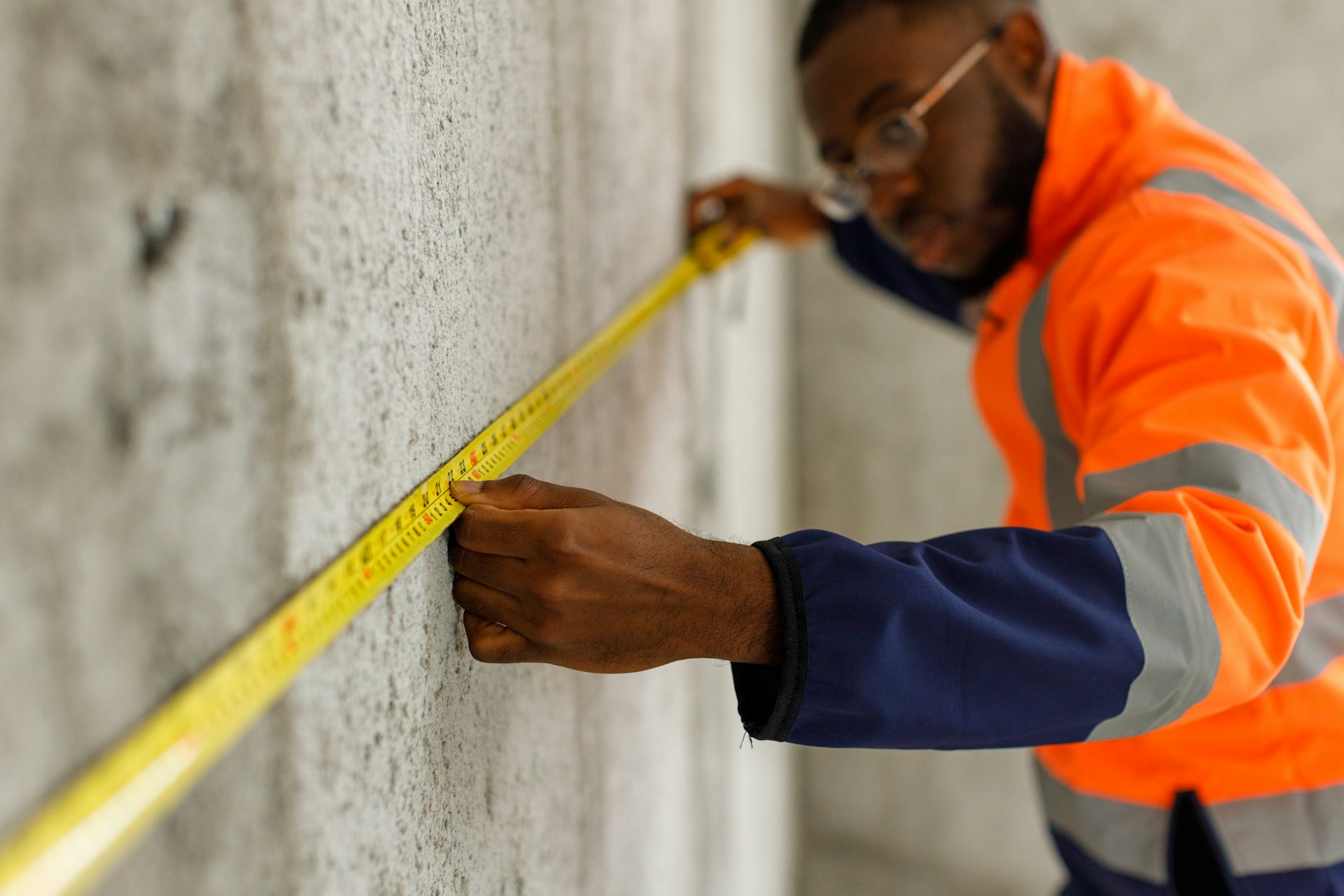
A laser distance measurer (Laserentfernungsmesser in German) fires a laser beam and calculates the distance to the opposite wall, accurate to ±1–2 mm at typical room distances. Entry-level models from Bosch (Zamo), Leica (Disto D1), or Stanley cost 30–80 EUR and are available at any hardware store. They are faster and more accurate than a tape measure, can be operated alone (no need to hold one end against the wall while you walk to the other), and produce a digital readout you simply note down.
Some models add area calculation and floor-plan scanning features, but a basic single-distance model is sufficient. You can handle the area arithmetic yourself on paper or in a spreadsheet.
Steel tape measure: the budget alternative
A 5-metre or 8-metre steel tape measure is accurate enough for apartment measurement and costs under 10 EUR. The limitation is that most rooms require two people — one to hold the end and one to read the measurement. Hooks and clips exist to hold the end against a wall solo, but they are fiddly. For a single visit where you want to be sure, bring a second person or invest in a laser measurer.
Recording: graph paper or app
Take graph paper and a pencil to sketch a rough floor plan as you go. Label each room or area with a number. Record your measurements directly on the sketch. Alternatively, use a note-taking app on your phone. Once home, enter the numbers into a simple spreadsheet: column A for dimension 1 (metres), column B for dimension 2 (metres), column C for area (A×B), column D for any height-reduction factor, column E for the adjusted area. Sum column E for the total.
Step-by-step measurement method
This method works for both the German WoFlV standard and the French loi Boutin standard. The only difference is the height thresholds applied in step 3.
Sketch the apartment layout
Walk through the apartment and draw a rough room-by-room outline on graph paper. You don't need scale accuracy at this stage — just a recognisable plan with each room labelled (living room, bedroom, kitchen, bathroom, hallway, and so on). Mark sloped ceilings where they exist. Note any alcoves, bay windows, or irregular corners.
Measure each room at floor level
Measure the internal length and width of each room: wall surface to wall surface, not including plaster or skirting boards. Record to two decimal places (e.g. 4.23 m × 3.18 m). For rectangular rooms, this produces a single length-width pair. For L-shaped rooms or rooms with alcoves, divide the space into rectangles and measure each rectangle separately.
Identify and measure sloped-ceiling areas
In rooms with sloped ceilings (typically loft conversions, top-floor apartments under a pitched roof), measure the horizontal distance from the wall to the point where the ceiling reaches the relevant height threshold. Mark this on your sketch: the area outside (below) the threshold is fully excluded (France) or reduced (Germany). For a room under a symmetrical pitched roof that is 4 m wide: if the full-height zone is 2.5 m wide at the centre and the 1m–2m zone extends 0.5 m on each side, the excluded zone below 1 m extends 0.5 m on each side. Note these dimensions separately from the main room measurement.
Identify excluded areas
Go through the apartment and identify anything that does not count: structural columns inside rooms (measure the room area as a rectangle and then subtract the column footprint), basement storage rooms, cellar compartments, garage or parking spaces, utility cupboards under stairs, and any technical spaces. In a German apartment, measure and note the balcony or terrace separately — it is not excluded, but it contributes at 25% (or 50%) rather than 100%. In a French apartment under loi Boutin, the balcony is excluded from the calculation entirely.
Calculate and sum
For each room: multiply length by width. For sloped sections: multiply the area of that section by the applicable factor (0%, 50%, or 100%). Add all room totals. For Germany, add the balcony area at 25% (or 50%). The result is your total Wohnfläche (Germany) or surface habitable (France). Check the arithmetic twice before publishing.
Compare to existing documentation
If you have an existing floor plan from the developer, a previous rental contract, or a Wohnflächenberechnung document, compare your result. A difference of up to 3% is normal and may reflect measurement method differences. A difference of more than 5% should be investigated: either your measurement is wrong, or the document is outdated or based on a different standard (e.g. DIN 277 vs WoFlV).
Tricky situations: slopes, alcoves, and irregular shapes
Mansard and loft rooms under a pitched roof
These are the most common source of measurement error. The slope begins at the eave and rises to the ridge. Divide the floor into three zones: the zone nearest the wall where the ceiling is below the exclusion threshold (0% in both standards, though at different heights), the mid-zone (Germany only: 50%), and the central zone where the ceiling is at full height (100%). Measure the depth of each zone by measuring horizontally from the wall to the point where the ceiling crosses the relevant threshold height. A wall-mounted laser measurer pointed horizontally works well for measuring these zone depths.
Bay windows and alcoves
Bay windows and alcoves that are permanently open to the main room count as part of the room's floor area. Measure the full floor area including the bay or alcove. A window embrasure (the reveal in the wall thickness) is excluded in France under loi Boutin; in Germany it is also not counted because it falls within the wall thickness rather than the habitable space.
Hallways and corridors
These count in full, provided the ceiling height meets the applicable threshold. Measure each straight section separately if the hallway is not a simple rectangle, then sum.
Digital tools and apps
Smartphone floor-plan apps have improved significantly since LiDAR sensors became standard on higher-end devices (iPhone 12 Pro and later; various Android models). These apps use the device camera and depth sensor to scan a room and automatically generate a floor plan with calculated dimensions. Three apps worth knowing about:
MagicPlan (iOS and Android) uses LiDAR and photogrammetry to produce a detailed floor plan with measurements. The basic scan is free; exporting professional formats (PDF, DXF, JPG) requires a subscription or per-export purchase. Accuracy is within 2–3% for rectangular rooms and slightly less for complex shapes.
RoomScan Pro (iOS) uses the device's accelerometer and camera to create floor plans room by room. It requires you to hold the phone flat against each wall to record the room boundaries. Accuracy is comparable to MagicPlan for standard rooms. It generates a simple, clearly labelled PDF that works well as a floor plan attachment for a rental listing.
Canvas by Trimble (iOS, LiDAR required) produces the highest-quality scans but is designed for professional use and is correspondingly more expensive per scan. If you are listing an apartment at a premium price point and want to include a professional floor plan in the listing or marketing materials, Canvas-quality output is worth considering.
For most Wunderflats landlords, either MagicPlan or RoomScan Pro is sufficient. The key caveat: app-generated floor plans are excellent for listings and internal use. For any legal dispute about the stated floor area — in either a German rental contract or a French bail meublé — a manually verified measurement with a laser measurer is more defensible than an app-generated figure.
Common measurement mistakes
Using the wrong standard. German DIN 277 is a construction standard, not a residential rental standard. If you use a floor plan marked "DIN 277" or if you measure to the outside of walls, you will arrive at a larger figure than the WoFlV Wohnfläche. Using that inflated figure in a rental contract creates a legal vulnerability. Always use WoFlV for Germany and loi Boutin for France.
Forgetting to exclude below-threshold ceiling areas. Loft and attic apartments look larger than they are when measured at floor level. A 50 m² loft floor area may become a 38 m² WoFlV Wohnfläche once the sloped sections are correctly weighted. Measure and apply the rules; do not simply measure the floor footprint.
Including balconies at full value in Germany. A 10 m² balcony in Germany adds 2.5 m² (25%) or at most 5 m² (50%) to the Wohnfläche — not 10 m². Many landlords make this error by adding the balcony at face value.
Measuring wall-to-wall including plaster and skirting board thickness. All standards require internal floor area measurements, which means the clear internal space between finished wall surfaces. In practice the difference between measuring to the plaster face versus the skirting board is small (1–2 cm per dimension), but using external or structural wall dimensions — which can be 20–30 cm thick — produces a significantly overstated figure.
Trusting the estate agent's or developer's figure uncritically. Developer floor plans are sometimes produced under DIN 277, sometimes under WoFlV, and sometimes under a mix of standards. They are not always updated after structural changes. Remeasuring yourself takes less time than investigating a rent-reduction claim.
Frequently asked questions about measuring an apartment
▶ What is Wohnfläche and how is it calculated in Germany?
Wohnfläche is the official German residential floor area measure, defined by the Wohnflächenverordnung (WoFlV) of 2004. It applies to all residential properties and is the correct standard for rental contracts, property listings, and valuation documents.
Under WoFlV, habitable rooms with a clear ceiling height of at least 2 metres are counted at 100% of floor area. Areas where the ceiling height falls between 1 metre and 2 metres are counted at 50%. Areas below 1 metre ceiling height are excluded. Balconies and terraces are counted at 25%, or at 50% for particularly high-quality or well-oriented outdoor spaces (determined by the standard). Cellars, garages, stairwells, heating rooms, and storage rooms outside the apartment are excluded entirely.
All measurements are internal: wall-to-wall distances inside the finished surfaces, not including wall thickness, plaster, or skirting boards. Structural columns or pilasters within a room are subtracted from the measured area.
▶ What is the surface loi Boutin and how does it differ from loi Carrez?
Loi Boutin (specifically article 3 of loi n° 89-462, as modified by loi Boutin 2009) requires landlords to state the surface habitable of the property in the rental contract for a primary residence. Surface habitable under loi Boutin excludes all areas where the ceiling height is below 1.80 metres, all structural elements (walls, partitions, pillars, stairways, and door and window embrasures), and all ancillary spaces including cellars, garages, parking spaces, terraces, balconies, loggia, and verandas.
Loi Carrez governs a different transaction: the sale of residential lots within a copropriété (co-ownership building). It requires the notaire to certify the surface privative of the unit in the sales contract. The loi Carrez surface also excludes areas below 1.80 metres ceiling height and ancillary spaces, but applies different rules to some categories (for example, the treatment of cellars associated with the lot differs between the two standards). For rental listing purposes, loi Boutin is the relevant standard — not loi Carrez.
If you received a loi Carrez certificate when you purchased your apartment, it may give you a useful starting reference but should not be copied directly into a rental contract as the loi Boutin figure. In practice, the two figures are often close; for an attic apartment with significant sloped-ceiling area, they can diverge by several m².
▶ Can I use a smartphone app to measure my apartment?
Yes, with some important caveats. Smartphone apps that use LiDAR (available on iPhone 12 Pro and later, and some Android flagship models) combined with AR technology can produce floor plans with accuracy typically within 2–5% of a manual laser measurement for standard rectangular rooms. Apps such as MagicPlan, RoomScan Pro, and Canvas are widely used by landlords and estate agents for creating listing floor plans. They are quick — a standard 50 m² apartment can be scanned in 15–20 minutes — and produce a visual floor plan that is useful both for internal reference and for sharing with prospective tenants.
The limitations: app accuracy decreases for irregular shapes, very long rooms, and rooms with complex features (bay windows, alcoves, built-in furniture). Apps also do not automatically apply WoFlV or loi Boutin rules for sloped ceilings — you need to apply those calculations manually after obtaining the raw floor area figures from the app.
For listing purposes and ordinary use, a well-executed app measurement is adequate for most furnished rental landlords. If the stated floor area is ever disputed in a German court under § 536 BGB (rent reduction for defective property), or in a French rental context under loi Boutin, a manually verified laser measurement documented at the time of listing is considerably more defensible than an app-generated figure.
▶ Does the stated apartment size in a German rental contract matter legally?
Yes, materially. German courts have consistently held that if the actual Wohnfläche of a rented apartment falls more than 10% below the figure stated in the contract, the tenant has a right to reduce their rent proportionally under § 536 BGB (Mietminderung wegen Sachmangel). The threshold is 10%: a difference below 10% is generally treated as within tolerance and does not trigger a reduction right.
The remedy is proportional: if the contract states 50 m² but the actual WoFlV area is 43 m² (14% less), the tenant can reduce the rent by 14%. German courts do not require the tenant to show that the reduced size affected their quality of life — the discrepancy itself is the defect.
The practical implication: it is safer to state the measured Wohnfläche conservatively (rounding down) than to round up. A 43.6 m² apartment listed as 43 m² generates no legal risk. Listed as 45 m², it creates a potential Mietminderung claim if the tenant measures it. Landlords who rely on a developer floor plan without remeasuring are particularly exposed if the developer used DIN 277 rather than WoFlV.
Sources
- Wohnflächenverordnung (WoFlV) 2003 (gesetze-im-internet.de)
- § 536 BGB: Mietminderung bei Sachmängeln (gesetze-im-internet.de)
- Loi n° 89-462 du 6 juillet 1989 (Loi Boutin — Article 3, surface habitable) (legifrance.gouv.fr)
- Service-public.fr: Surface à déclarer dans le contrat de location (service-public.fr)
- DIN 277: Grundflächen und Rauminhalte im Bauwesen (din.de)